Vecura Biotech Insiders Spotlight #15: The Right Region, the Wrong Twenty Nucleotides
For Vecura Biotech Insiders Spotlight #15, Tan Wei Ming shares the whole campaign, including the corrections it produced and one headline it does not claim.
A MAPT gapmer campaign run end to end on the Vecura platform, and what a two-nucleotide walk showed about site selection
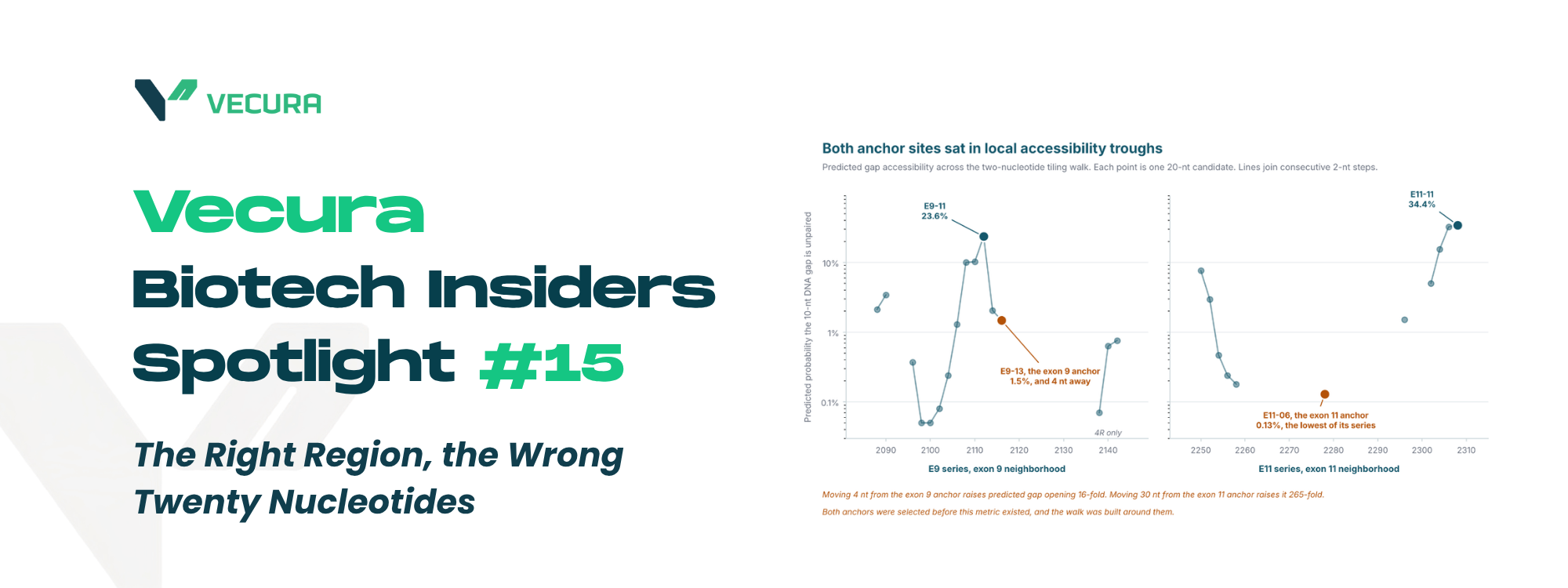
Two target sites for a tau-lowering gapmer were selected on conservation, uniqueness and exon assignment. A two-nucleotide tiling walk across both then showed that each sits in a local trough of predicted accessibility, with far better sites a few nucleotides away. The exon 9 site ranks seventh of the thirteen tiles in its own walk, and four nucleotides along predicted gap opening is sixteen times higher. The exon 11 site is the lowest of all eleven tiles in its series, and a tile thirty nucleotides away is two hundred and sixty five times higher.
Both sites were chosen before the accessibility metric existed. Conservation, uniqueness and exon assignment are reasonable criteria and they reached roughly the right stretch of transcript. They did not reach the right twenty nucleotides inside it.
Scope and intent
This was a test campaign, run to exercise the full antisense workflow on a genuinely hard target rather than a toy problem. MAPT suits that purpose because the biology is well described, a clinical comparator exists, and the design constraints actually bite. Nothing here is headed for synthesis, nothing has been tested, no experiments are commissioned and there is no lead. The useful output of a run like this is the method and the corrections, which are worth more to a reader than a candidate list nobody intends to order.
| Parameter | Value |
| Target | MAPT (tau), human, ENSG00000186868, reference transcript ENST00000262410.10, 6,815 nt |
| Modality | RNase H1 gapmer, 20 nt, 5-10-5 2'-O-MOE wings and PS-DNA gap, full phosphorothioate, proposed not ordered |
| Panel | 62 tiles generated, 46 initially selected, 27 screening candidates (11 E11 series, 16 E9 series) |
| Controls | 3 proposed negative controls, unqualified. 1 positive-control slot, unfilled |
| Manifest | 31 planned entries, 30 actual sequences |
| Off-target model | 0 to 3 substitutions, or one internal 1-nt bulge with 0 to 2 substitutions, across mature and precursor sequence |
| Accessibility | ViennaRNA 2.7.2 pfl_fold_up, mature RNA only, 8 RNA contexts, 5 parameter sets, 40 folds |
| Promoted or removed by any filter | None. All 27 candidates were retained throughout |
Table 1. Run snapshot. Every value traces to a named artifact in the campaign workspace.
Why this target needs an oligonucleotide
Tau is intrinsically disordered and has no conventional small-molecule binding pocket, which puts it outside what classical medicinal chemistry can reach. Lowering it at the RNA level is one of the few tractable routes and the one with clinical precedent: BIIB080, also called MAPTRx or ISIS 814907, is a 2'-MOE gapmer that binds MAPT pre-mRNA within intron 9 and reduced cerebrospinal fluid tau in a phase 1b trial. Delivery, which blocks RNA therapeutics in most organs, is already solved in principle here, since intrathecal administration is routine and approved through nusinersen and tofersen.
A caveat about that benchmark belongs in the body rather than a footnote. The phase 1b paper was read only as a search snippet, so every statement about the clinical comparator in this piece rests on that snippet, and its per-position chemistry was not verified. The one sequence string located for it contained invalid characters and a length inconsistent with the stated 18-nt target stretch, so it was discarded rather than built on.
The panel is a walk, not a scan
This matters for reading everything below, so it goes before the results. The 27 candidates are not 27 independent sites. They are a two-nucleotide tiling walk across three short stretches, spanning positions 2088 to 2135, 2138 to 2161 and 2250 to 2327, which is about 150 nucleotides of a 6,815-nucleotide transcript, a little over two percent of it, and neighboring tiles share 18 of their 20 bases.
The walk was built around the two previously selected sites. That is the right design for asking how much the exact register matters and the wrong design for asking which sites in MAPT are most accessible. No transcript-wide accessibility scan was run, even though the folding tool computes one, and that is the analysis that should have come first.
Both anchors sit in local troughs
Predicted accessibility of the 10-nt DNA gap moves sharply over very short distances. Inside the exon 9 walk it changes roughly 460-fold across fourteen nucleotides, from 0.05 percent at position 2098 to 23.6 percent at position 2112. A twenty-mer is not a point on a smooth landscape. It is a specific window, and sliding it by a few bases can move the predicted opening by orders of magnitude.
Figure 1. Predicted gap accessibility across both walks. Lines join consecutive two-nucleotide steps. Orange marks the two previously selected anchor sites.
Against that, both anchors land badly. E9-13 sits at 1.48 percent, seventh of the thirteen tiles in its contiguous walk, with E9-11 four nucleotides away at 23.6 percent. E11-06 sits at 0.13 percent, the lowest value of any tile in the entire E11 series, with E11-11 thirty nucleotides away at 34.4 percent. The anchors were not chosen badly. They were chosen on criteria that do not see secondary structure, and a metric that does see it was applied afterwards. The lesson is about ordering rather than judgment.
The reach of this result is limited. Predicted accessibility of naked RNA is a proxy with no calibrated relationship to cellular knockdown, so a 265-fold difference in predicted opening is not a 265-fold difference in potency, and a site in a trough can still be a perfectly good target. What the walk establishes is that the metric varies steeply at this scale, which means that if accessibility matters at all, choosing a site without looking at it leaves a lot on the table.
Exon assignment determines the indication
Twenty-four of the 27 candidates have exact 20-nt sites in all six major CNS tau isoform classes, 22 of them wholly exonic and two spanning the reference exon-rank 11 to 12 junction. Three candidates, E9-14, E9-15 and E9-16, are exact in 4R mature RNAs only, and they are not 4R-selective on this evidence: their homologous 3R sites still match at 19 of 20, 18 of 20 and 16 of 20, close enough that selectivity has to be measured rather than assumed. They also sit near the bottom of the accessibility ranking, so they are low priority on both counts.

Figure 2. Exon presence across the 36 protein-coding MAPT transcripts. Exon 10 is the alternatively spliced exon separating 3R from 4R tau.
Cross-species identity proved to be a preference the panel could not afford to enforce. Thirteen candidates are exact in the selected rhesus transcript, three in mouse, and only two in both, so a panel built to require all three species would have been a panel of two. The requirement was recorded as a design preference and the constraint relaxed. That is a real weakness in the translational story and it is worth stating plainly rather than burying.
An observation not claimed as a finding
The four most accessible candidates are also the four carrying the closest near-matches found anywhere in the off-target screen. E11-11 and E11-10 rank first and second and carry same-start precursor matches at 18 of 20 and 19 of 20 with the gap intact, E9-11 ranks third and matches the PRIM2 precursor at 19 of 20, and E11-09 ranks fourth and matches the WAPL precursor at 19 of 20.
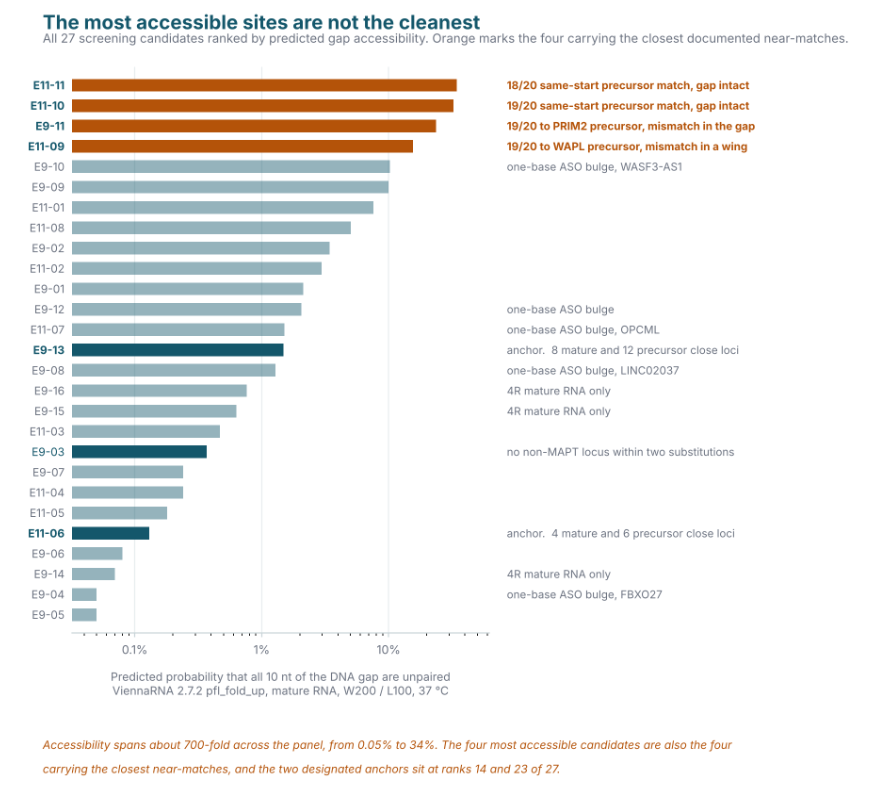
Figure 3. All 27 candidates ranked by predicted gap accessibility, with the closest documented near-matches marked.
| Rank | Candidate | p(gap10 unpaired) | Opening penalty | Rank range | Closest documented near-match |
| 1 | E11-11 | 34.4% | 0.66 kcal/mol | 1 to 2 | 18 of 20 same-start precursor, gap intact |
| 2 | E11-10 | 32.4% | 0.70 kcal/mol | 1 to 2 | 19 of 20 same-start precursor, gap intact |
| 3 | E9-11 | 23.6% | 0.89 kcal/mol | 3 to 4 | 19 of 20 to PRIM2 precursor, mismatch in the gap |
| 4 | E11-09 | 15.5% | 1.15 kcal/mol | 3 to 4 | 19 of 20 to WAPL precursor, mismatch in a wing |
| 14 | E9-13 (anchor) | 1.48% | 2.60 kcal/mol | 13 to 14 | 8 mature and 12 precursor close loci |
| 19 | E9-03 | 0.37% | 3.45 kcal/mol | 19 to 23 | no non-MAPT locus within two substitutions |
| 23 | E11-06 (anchor) | 0.13% | 4.07 kcal/mol | 21 to 24 | 4 mature and 6 precursor close loci |
Table 2. The accessibility leaders, the two anchors and the cleanest candidate. Ranks are baseline W200 / L100 and the range covers five parameter sets.
That pattern invites a write-up as a trade-off between accessibility and specificity, and it is not claimed as one here, for two reasons. The first is the tiling: E11-09, E11-10 and E11-11 start at positions 2304, 2306 and 2308, so they are the same site sampled three times, and overlapping tiles share their near-matches by construction. What looks like four candidates agreeing is closer to two loci, each of which happens to be both accessible and to carry a near-match.
The second is a confound that has not been ruled out. Across the panel, GC content of the DNA gap correlates with predicted accessibility at a Spearman coefficient of minus 0.71, with the accessibility leaders at 30 percent gap GC and the bottom six running from 50 to 70 percent. Since the human transcriptome is AT-rich, low-GC twenty-mers should also pick up more near-matches by chance, so both axes may be reading out base composition rather than standing in genuine tension. A finding that would be interesting if true is exactly the kind to check hardest before publishing. This one needs a transcript-wide panel and a GC-matched comparison, and until then it is a hypothesis with two supporting observations.
Why a wing mismatch is worse than a gap mismatch
Whatever the status of the trade-off, the two 19 of 20 hits are not equally worrying, and the reason is mechanistic rather than numerical. RNase H1 cleaves the RNA strand of a DNA to RNA heteroduplex, and in a gapmer it is the central DNA gap that forms that duplex. A mismatch inside the gap disrupts the structure the enzyme requires, so it is protective. A mismatch in a MOE wing costs binding affinity but leaves the gap cleavage-competent. So the WAPL match carried by E11-09 is the more serious of the two, because its single mismatch is in a wing and its gap is intact, while the PRIM2 match carried by E9-11 has its mismatch in the gap. Both are 19 of 20, and counting alone cannot tell them apart.
An earlier version of this campaign had it backwards. The mechanism was stated correctly in the methods and applied the wrong way round in the interpretation two paragraphs later, so intact-gap near-matches were being read as the safe ones. Nothing in the code was wrong and no output was impossible. A reader checking the argument against the primary literature caught it.
What the accessibility number does not say, and why the controls are not controls
The metric is the joint probability that all 10 nucleotides of the DNA gap are simultaneously unpaired. The equivalent probability for the whole 20-nt site is far smaller, with a median of 0.013 percent and a maximum of 0.54 percent across the panel, so these values describe local gap breathing rather than full-site opening. They are also equilibrium predictions for naked RNA, ignoring RNA-binding proteins, ribosomes, co-transcriptional folding, pseudoknots, pairs beyond the configured maximum span and any remodeling the oligonucleotide itself causes. Isoform context shifts them modestly, with the largest spread across the six CNS isoform RNAs being 4.2-fold for E11-06 and most sites varying less than about two-fold, and the rankings themselves hold at a Spearman correlation of 0.90 between the mildest and the most aggressive folding settings.
Accessibility was computed on mature RNA only. Precursor accessibility was not computed, and that is a required next step rather than an optional refinement, because the clinical comparator for this target acts inside an intron and nuclear pre-mRNA is the primary gapmer substrate. Until the precursor is folded, the ranking describes a compartment that may not be the one that matters.
The controls are in a similar state. Three scrambled negative controls are proposed and none is qualified: SCRAMBLE-02 has an 18 of 20 precursor match to the lncRNA ENSG00000306793, which disqualifies it until it is replaced or re-screened, and the other two were screened computationally only. The positive-control slot is unfilled, with BIIB080 recorded as a provisional published benchmark rather than an available reagent. A positive control that has not been shown to work in the specific assay is not a control. It is another unknown in the same plate as the things being measured.
The corrections, and what each one took
The errors in this campaign have been published as they were found. Two more surfaced during the accessibility and off-target work, and both produced plausible numbers rather than obviously broken ones, which is the kind that survives a casual look.
| Correction | What it took to find |
| The accessibility matrix is indexed by END position, contrary to the installed docstring | Six independent hard-constrained partition-function tests, agreeing to within about 7 in 10 million |
| A legacy seed-based off-target prefilter missed 198 of 287 close non-target mature alignment rows, across 18 query-gene pairs | Re-running the same annotation release under an exhaustive search and comparing row counts |
| Legacy accessibility fields were not joint opening probabilities but had been read as if they were | Re-deriving the metric definition and archiving the old fields under a name that cannot be misread |
| A single partition-function fold of the full 6,815-nt transcript is numerically degenerate | Re-running the same analysis under local windowed folding and comparing |
| A site recorded as a constitutive exon was in the alternatively spliced exon 10 | Re-running the scan with explicit boundary mapping instead of inherited annotation |
| Wing and gap mismatches were interpreted in the wrong direction | Nothing that could be re-run. A reader checking the argument against the literature |
Table 3. Five of these were found by going back to something already run. The last one could not have been.
The replacement off-target search was validated before it was trusted, across 22,385 synthetic cases, 30,780 exhaustive three-substitution sequences, 106 brute-force unique-site checks and 6,000 coordinate checks, recovering every planted site with no false negatives, no false positives and no coordinate failures. Those guarantees cover the stated edit model on ACGT references and nothing beyond it.
The prefilter is the most instructive of the six. It was not producing absurd output, it was producing a shorter list of off-target hits, and a shorter list looks like good news. An error that makes results worse announces itself. An error that makes them better has to be hunted, and this one surfaced only because a finished analysis was re-run without any particular reason to doubt it.
What exists, what does not, and what would be done differently
What exists is a ranked and fully annotated panel of 27 screening candidates, with every site mapped across 55 annotated human MAPT transcripts, seven RefSeq records covering the six CNS isoform classes and the selected rhesus and mouse transcripts, an exhaustive complementarity screen returning 21,549 non-MAPT sites across 5,417 gene-locus identifiers, expression annotation for 121 close gene loci, and accessibility for every exact site under five folding parameter sets.
What does not exist is a lead, and that was never the point. No filter removed or promoted a single candidate, so the result is an annotation layer rather than a triage. There is no cleavage, expression, delivery, toxicity or target-engagement data, no modified MOE and PS duplex energetics, and no calibrated efficacy threshold. Complementarity counts are a triage aid rather than a safety assessment, and for this chemistry they do not touch the phosphorothioate protein-binding effects that account for a good deal of real gapmer attrition.
Four things would be done differently. Scan the whole transcript for accessibility before choosing any site, since the folding tool already computes the array across all 6,815 nucleotides and here it was used to rank 27 tiles around two sites picked on other grounds; that single reordering would have cost nothing and changed the panel. Fold the precursor rather than just the mature RNA, given that the modality acts in the nucleus and the clinical comparator binds an intron. Qualify the controls before anything else is designed around them. And be honest about where in-silico triage earns its keep: at 27 candidates, computational prioritization is competing against simply testing all of them, and a plate at three doses would produce better information in two weeks than any amount of further prediction. The modeling pays for itself when the candidate space is thousands wide. At this size its real value was showing that the site selection was off by a few nucleotides, which is worth knowing, and which the ranking alone would not have shown.
Scope
All results described here are computational and none is evidence of potency, selectivity or safety. No oligonucleotide in this set has been synthesized or tested, and no experiments are commissioned. Accessibility values are predicted equilibrium opening probabilities for naked RNA computed with ViennaRNA 2.7.2 on mature RNA only, and are not binding free energies, duplex melting temperatures or measured cellular accessibility. Off-target counts derive from a stated edit model over mature and precursor sequence and exclude larger bulges, multiple indels, more than three substitutions, patient variants and unannotated transcription. Statements about the clinical benchmark rest on a search snippet of the source publication, which was not read in full.
立即试用 Vecura。
带上您自己的输入,开始探索 Vecura 的能力。