From Prediction to Decision: Choosing Graph-Based AI Models for Drug-Target Interaction Research
How an output-driven perspective can help researchers select graph-based AI models for drug-target interaction research, with a closer look at DTIGN and LigoSPACE.


VECURA RESEARCH · NEW PEER-REVIEWED PUBLICATION
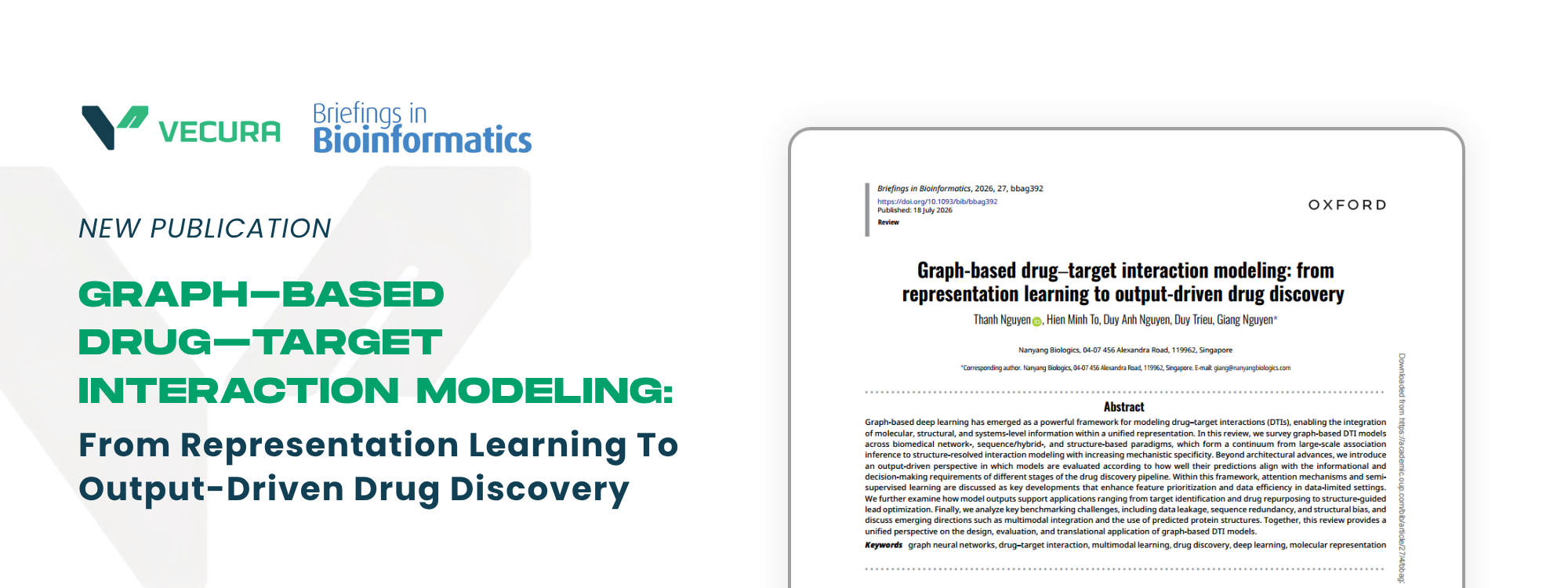
Published in Briefings in Bioinformatics and now available on Oxford Academic, the review introduces an output-driven perspective on graph-based drug–target interaction modeling, featuring NYB.AI**’s proprietary models DTIGN and LigoSPACE.
A benchmark score is not the research decision
Graph-based artificial intelligence has become an important approach for modeling drug-target interactions (DTIs). By representing atoms, residues, molecules, proteins, or biomedical entities as connected nodes, graph models can bring chemical, structural, and systems-level information into a common computational framework.
Yet the growing number of architectures creates a practical question: what makes one model useful for a particular stage of drug discovery? A high score on a benchmark may look persuasive, but it does not automatically tell a researcher whether the model can support association discovery, affinity prediction, structure-aware screening, binding-site hypothesis generation, or lead prioritization.
The newly published review, Graph-based drug-target interaction modeling: from representation learning to output-driven drug discovery, proposes an output-driven perspective. Instead of comparing models only by architecture or aggregate performance, it asks whether a model's output matches the information and decision required at the point where it will be used.
One field, different levels of resolution
The review organizes graph-based DTI models across four broad representation levels: network-based, sequence-based, structure-based, and interaction-focused approaches.
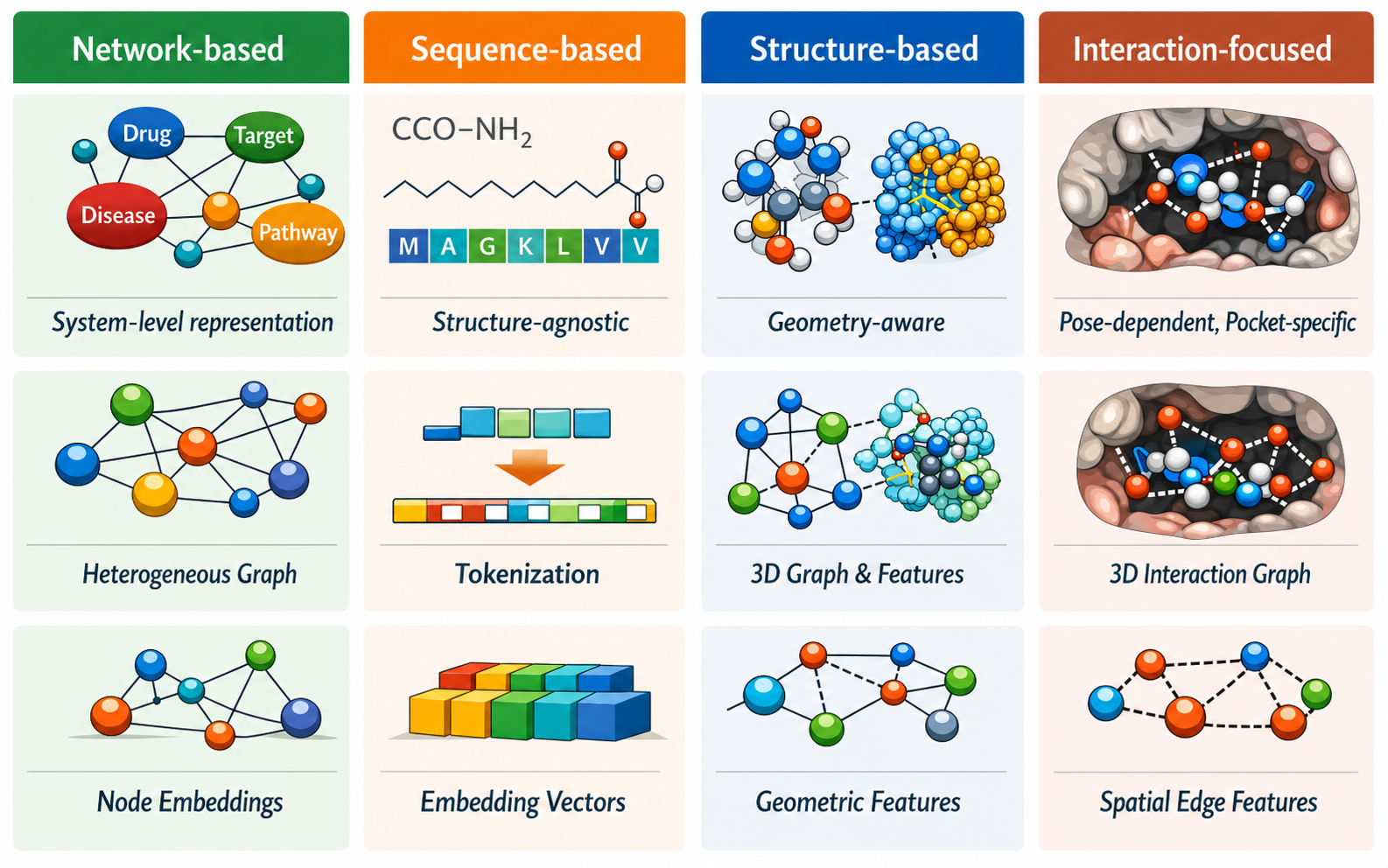
Figure: Representation frameworks in graph-based DTI models, spanning different levels of biological abstraction and structural resolution. Reproduced from Nguyen et al. (2026), Briefings in Bioinformatics
Graph-based DTI models operate across a continuum of biological abstraction. At one end, biomedical network models connect drugs, proteins, diseases, and pathways... Graph-based DTI models operate across a continuum of biological abstraction. At one end, biomedical network models connect drugs, proteins, diseases, and pathways to infer broad associations and support hypothesis generation. These approaches can be valuable for target identification and drug-repurposing questions, although they generally offer limited direct information about molecular binding.
Sequence and hybrid models combine ligand representations with protein sequence encoders. They can scale to settings where reliable three-dimensional structures are unavailable and may support interaction or affinity prediction across many targets. Their outputs, however, usually provide less direct information about binding geometry unless structural or interaction-level features are added.
Structure-based approaches introduce three-dimensional information from ligands, proteins, pockets, or protein-ligand complexes. Interaction-focused variants place greater emphasis on atom-residue contacts, pocket context, pose sensitivity, or ranking objectives. This additional resolution can support more specific molecular hypotheses, but it also increases dependence on the quality of structures, pocket definitions, and docking poses.
These categories are not rigid. Multimodal models increasingly combine molecular graphs, protein sequences, structures, and biomedical networks. The useful distinction is therefore not simply which model family is newest. It is what information each representation can reliably contribute to the next research decision.
Model spotlight: DTIGN and LigoSPACE
DTIGN and LigoSPACE are Vecura's own proprietary models. Within the review's interaction-focused structure-based category, our team situates both alongside the wider published literature rather than presenting them as independently benchmarked against it. Their inclusion illustrates a concrete example of how model design can move from generic interaction prediction toward outputs that incorporate pocket geometry, protein-ligand contacts, pose context, and ranking objectives.
DTIGN centers on local binding-pocket context and explicit protein-ligand interaction features, using learned weighting to model which contacts are informative for bioactivity prediction. LigoSPACE extends the perspective toward broader pocket geometry and spatial occupancy, combining information across pockets with ranking-aware learning to assess binding relevance in a wider structural context.
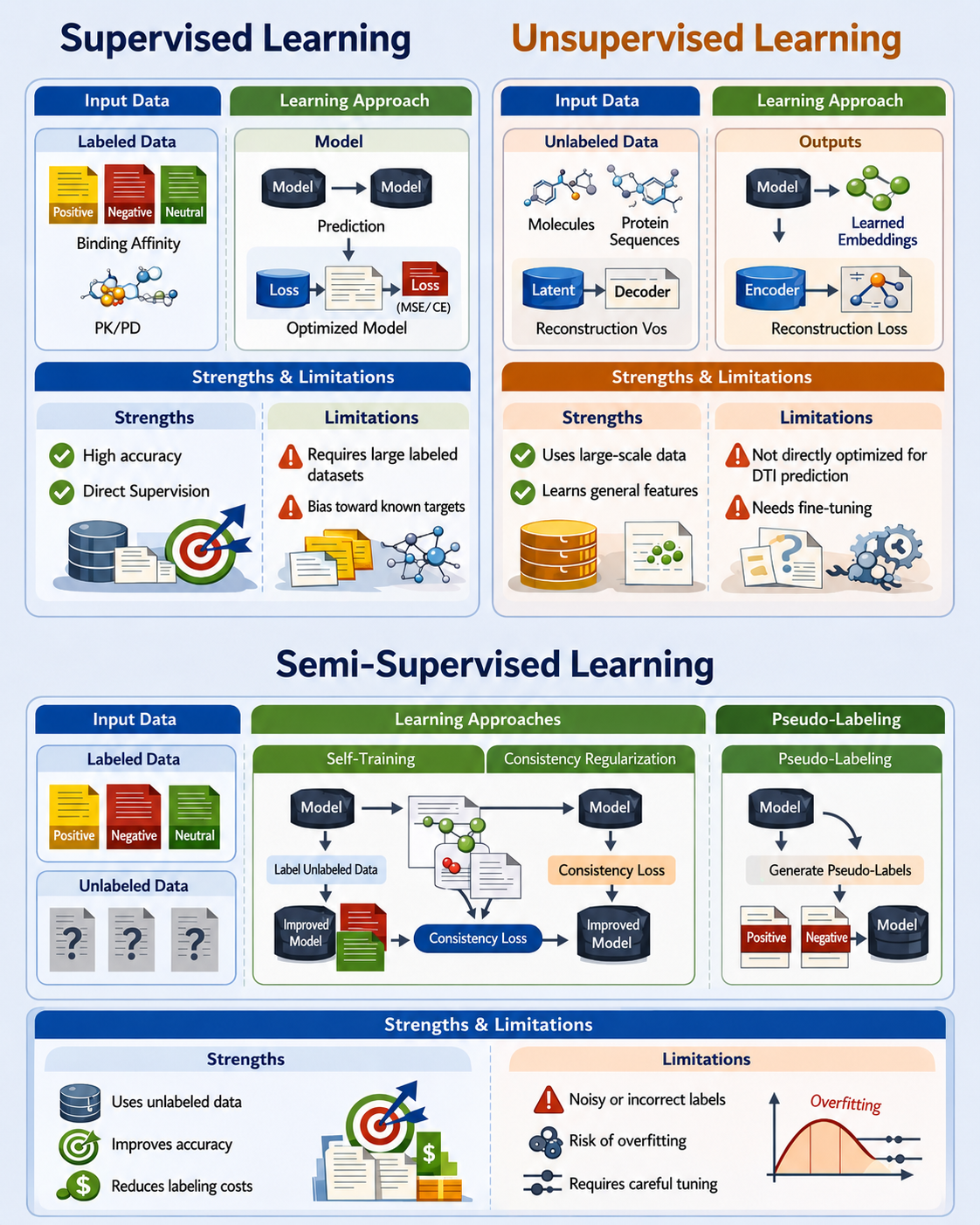
Figure: A general comparison of supervised, unsupervised, and semi-supervised learning. This conceptual illustration provides context for the semi-supervised component explored in the original DTIGN study; it does not represent the DTIGN architecture.
In this review, our team discusses and classifies both models alongside advances from the wider DTI field. As with any model included in the review, DTIGN and LigoSPACE were not newly trained, benchmarked, or experimentally validated for this publication, and their original performance claims belong to their respective source studies and should be cited separately if used.
Match the output to the question
A model that returns an association score may be suitable for broad prioritization. An affinity estimate can help rank compounds within a defined screening context. A structure-resolved output may support pocket- or pose-level interpretation when the structural inputs are sufficiently reliable. Contact-level outputs can help form hypotheses about molecular recognition, but they should not be treated as confirmed mechanisms.
This distinction matters because the same performance metric can hide very different scientific utility. Binary interaction classification, affinity regression, virtual screening, and pose discrimination are different tasks. Their evaluation should reflect what a user intends to do with the result.
For researchers, an output-driven approach starts with five questions: What decision will the output support? What input data are available, and how reliable are they? How much mechanistic resolution is needed? Was the model tested under a realistic generalization setting? What experimental evidence is required before acting on the prediction?
Attention is useful evidence, not automatic explanation
Attention mechanisms can help a model assign different weights to biomedical relationships, sequence regions, binding-site features, or ligand-protein contacts. Their function depends on the underlying representation. In one model, attention may prioritize entities in a heterogeneous network; in another, it may highlight sequence tokens or spatial contacts.
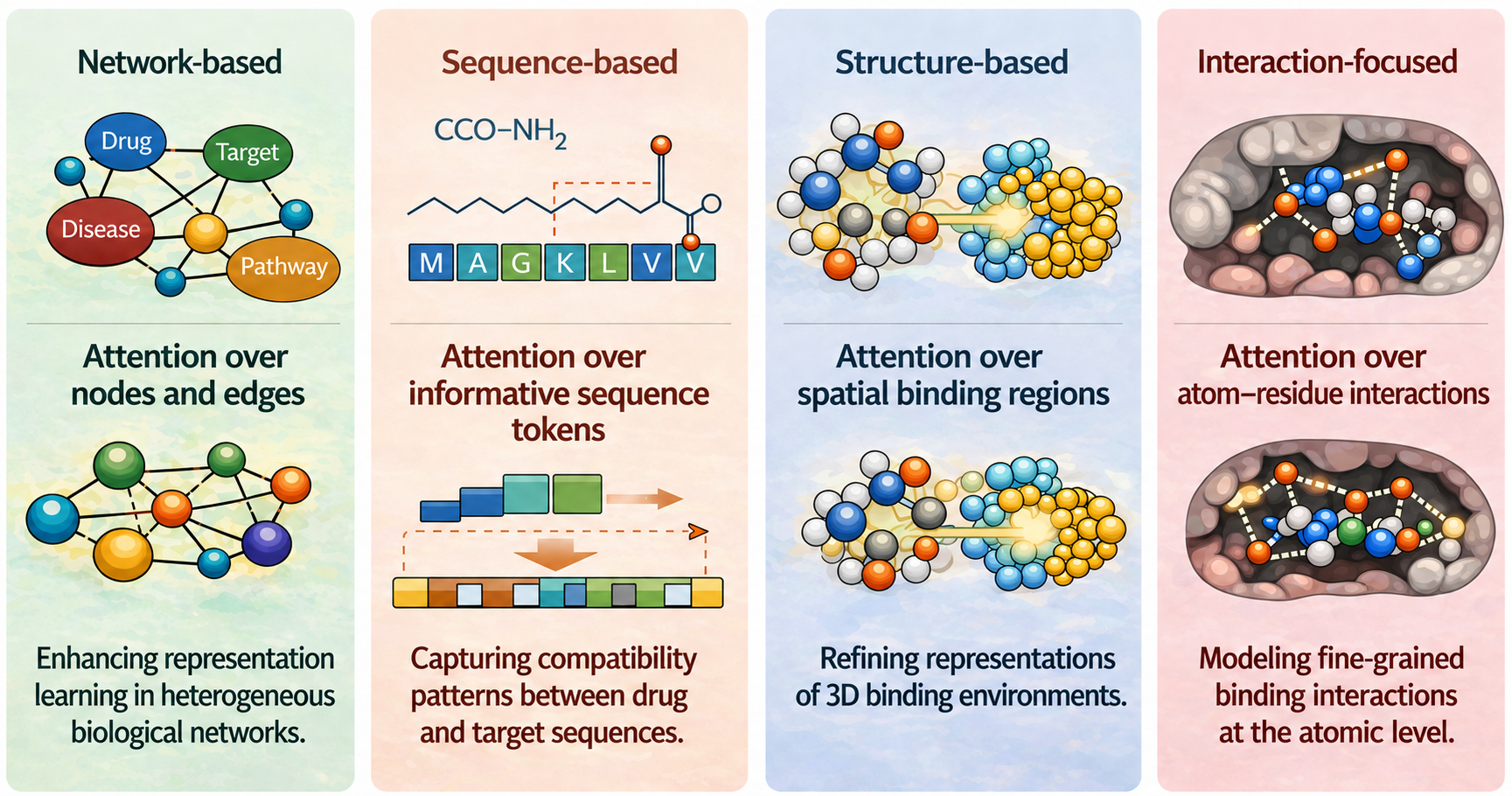
Figure: How attention mechanisms operate across different graph-based DTI model classes, from weighting network relationships and sequence tokens to prioritizing spatial binding regions and atom-residue interactions. Reproduced from Nguyen et al. (2026), Briefings in Bioinformatics**.
That flexibility makes attention valuable for representation learning and feature prioritization. It does not make every attention weight biologically interpretable. The review cautions that attention weights should not be assumed to identify physical interaction sites or provide direct mechanistic explanations without additional structural or experimental validation.
A careful interpretation is therefore: attention can indicate which features contributed to a prediction under a specific model and dataset. It can generate hypotheses, but it is not proof of a binding mechanism.
Why impressive benchmarks can mislead
Reported model performance depends on more than architecture. Dataset construction, splitting strategy, class balance, negative sampling, structural inputs, and evaluation metrics can all shape the result.
Random splits often measure performance within chemical and target spaces that are already familiar to the model. They may not show whether the model can generalize to a new scaffold, an unseen drug, an unfamiliar target family, or a different structural context. More stringent evaluations can include scaffold splits, cold-drug or cold-target tests, sequence-identity controls, pocket-similarity controls, and external datasets.
Negative labels introduce another challenge. In many public DTI datasets, a pair may be treated as negative because no interaction has been recorded, rather than because non-binding has been experimentally confirmed. Some presumed negatives may be unobserved or weak interactions, which can affect both training and evaluation.
For structure-based models, docking protocols and pose quality can introduce additional bias. If benchmark complexes or similar structures leak information into training, reported accuracy may overstate performance in less familiar settings. Transparent reporting is therefore essential for fair model comparison.
A practical decision framework for DTI model selection
The following framework translates the review's output-driven perspective into a practical selection process.
-
Define the decision. Clarify whether the task is association discovery, interaction classification, affinity estimation, candidate ranking, pocket identification, pose assessment, or mechanistic hypothesis generation.
-
Audit the inputs. Identify which ligand, sequence, structural, interaction, network, or experimental data are available. Record uncertainty in predicted structures, docking poses, labels, and negative samples.
-
Choose the required resolution. Use the least complex representation that provides enough information for the decision. Greater structural detail can add value, but only when the inputs and evaluation support it.
-
Examine the evaluation design. Check data splits, similarity controls, class balance, negative sampling, metrics, and whether performance was tested on unseen ligands, targets, or external data.
-
Plan validation before interpretation. Treat model outputs as decision-support evidence. Define the biochemical, biophysical, cellular, mutagenesis, or structural experiments needed to confirm the hypothesis.
From prediction toward an iterative discovery workflow
The future direction described in the review is broader than a single model architecture. It includes multimodal integration, more realistic benchmarking, uncertainty-aware use of predicted structures, and tighter feedback between computational prediction and experimental validation.
That feedback loop is central to useful AI-assisted discovery. Predictions can prioritize candidates or propose explanations. Experiments test those proposals. The resulting evidence can then refine datasets, improve confidence estimates, and guide the next round of modeling.
The practical takeaway is simple: start with the biological question and the decision to be made. Then select the representation, output, evaluation, and validation strategy that fit that decision.
About the publication
This article is an editorial interpretation of the peer-reviewed review authored by Thanh Nguyen, Hien Minh To, Duy Anh Nguyen, Duy Trieu, and Giang Nguyen, published in Briefings in Bioinformatics on 18 July 2026. It does not reproduce the journal article and should be read alongside the original publication. DTIGN and LigoSPACE are discussed as representative interaction-focused models; this review does not report new experiments using either model.
Full citation: Nguyen T, To HM, Nguyen DA, Trieu D, Nguyen G. Graph-based drug-target interaction modeling: from representation learning to output-driven drug discovery. Briefings in Bioinformatics. 2026;27(4):bbag392. https://doi.org/10.1093/bib/bbag392
Read the peer-reviewed paper
Read the full review on Oxford Academic.
Explore Vecura
Explore how AI tools can support drug-target interaction research on Vecura.
立即试用 Vecura。
带上您自己的输入,开始探索 Vecura 的能力。