RFpeptides Is Now Available on Vecura for Macrocyclic Peptide Design
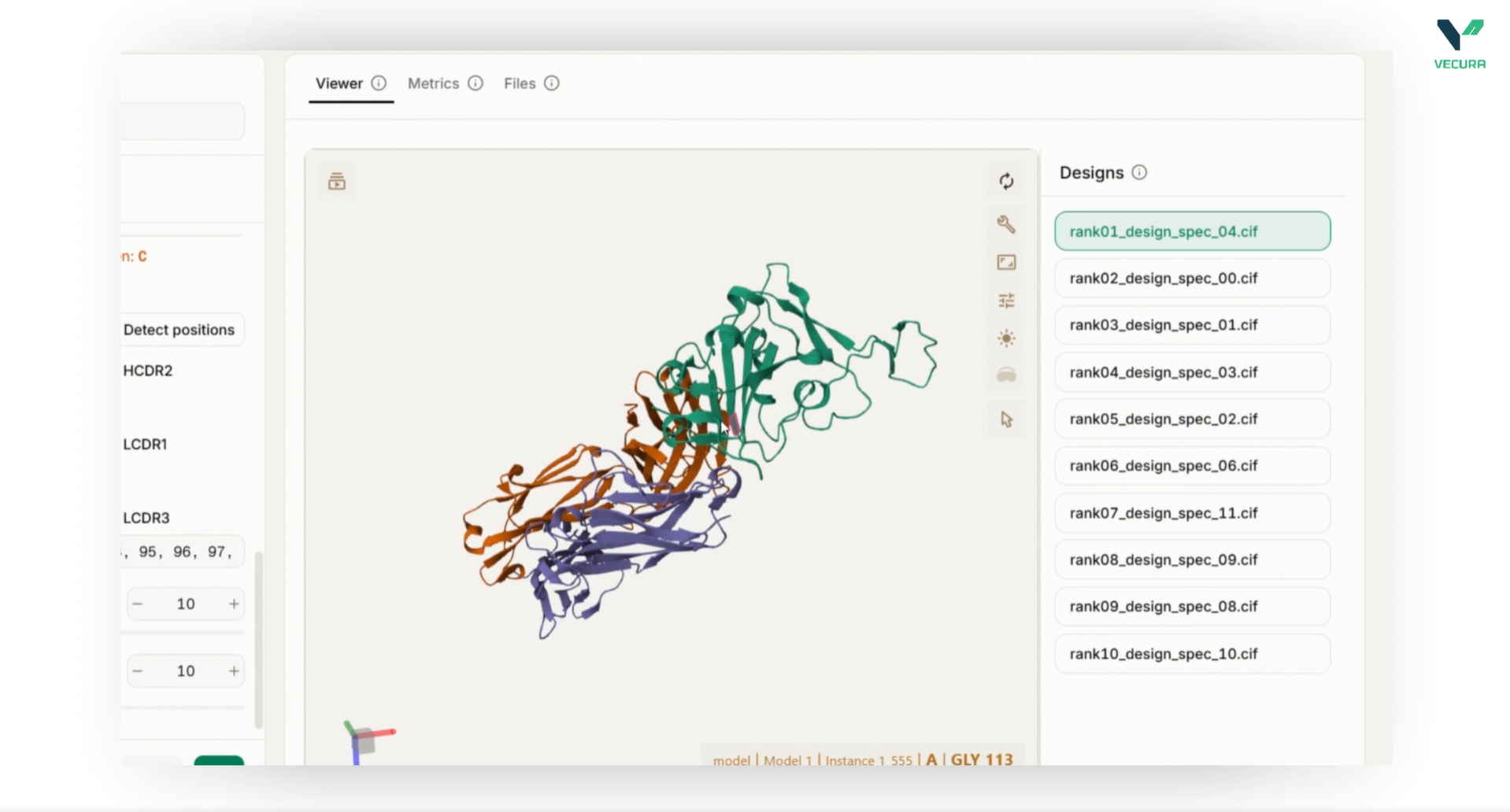
This update enables computational biologists, peptide engineers, and drug discovery researchers to design macrocyclic peptide backbones — either as free-standing monomers or as binders targeting specific proteins — through a guided workflow inside Vecura, without setting up complex GPU infrastructure or managing RFdiffusion dependencies.
What is RFpeptides?
RFpeptides is a denoising diffusion-based generative model built on top of RFdiffusion, designed to create macrocyclic (head-to-tail cyclized) peptide backbone structures from scratch. It generates structurally diverse cyclic peptide scaffolds — typically 12 to 18+ residues in length — without relying on any pre-existing ring topology or template structure. The model outputs glycine-only backbone coordinates (N, CA, C, O atoms), which can then be passed to downstream sequence-design tools like ProteinMPNN to assign actual amino acid identities.
It helps users design cyclic peptide backbones de novo, either as free monomers for scaffold exploration or as binders that dock against a specified target protein. It is especially useful for peptide therapeutics discovery, where macrocyclic peptides offer enhanced stability, bioavailability, and target affinity compared to their linear counterparts.
What can users do with RFpeptides on Vecura?
With RFpeptides on Vecura, users can:
-
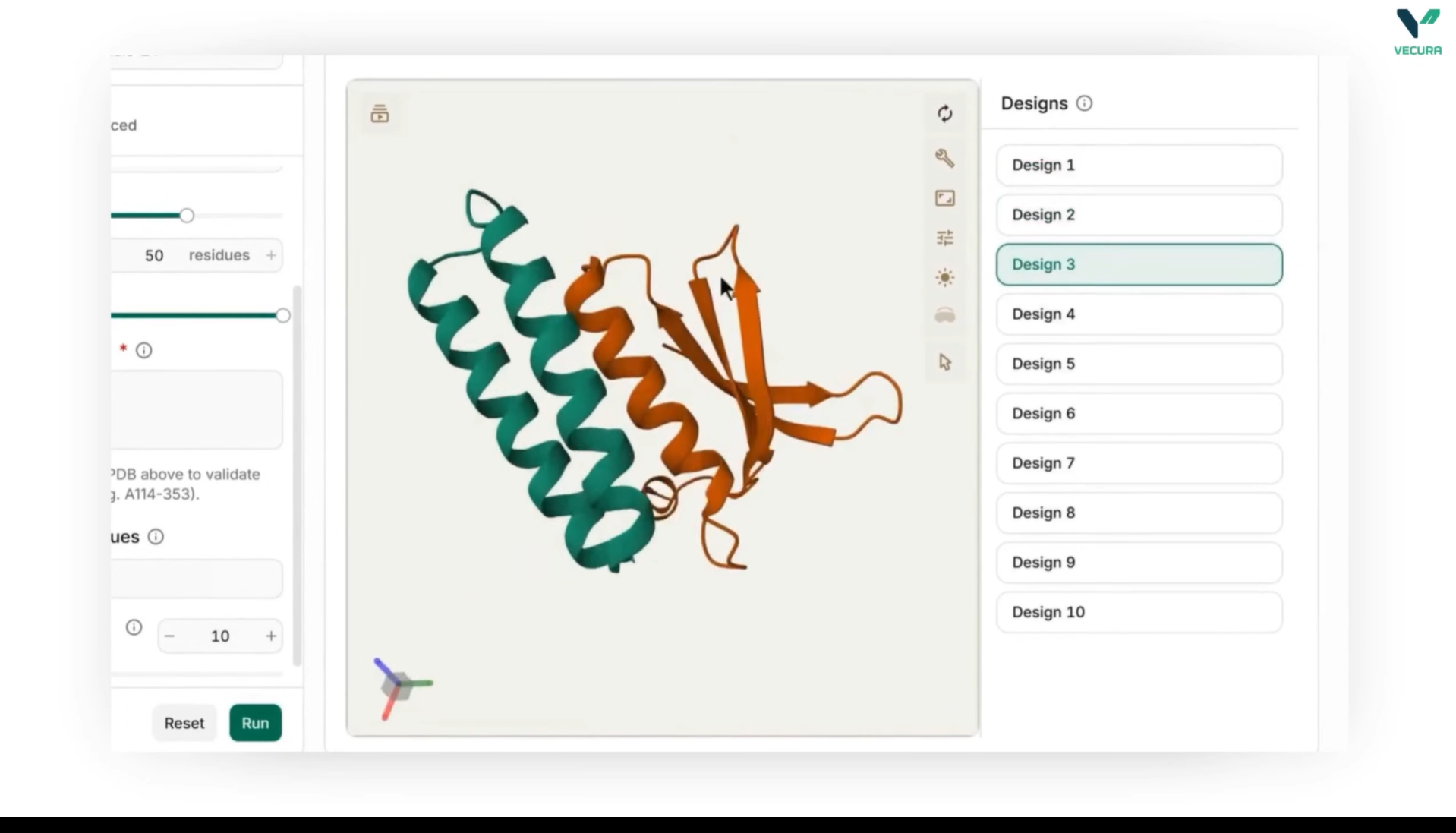
Design macrocyclic monomers — Generate libraries of diverse cyclic peptide backbones of user-defined ring sizes (e.g., 12–18 residues) for downstream sequence design and chemical space exploration.
-
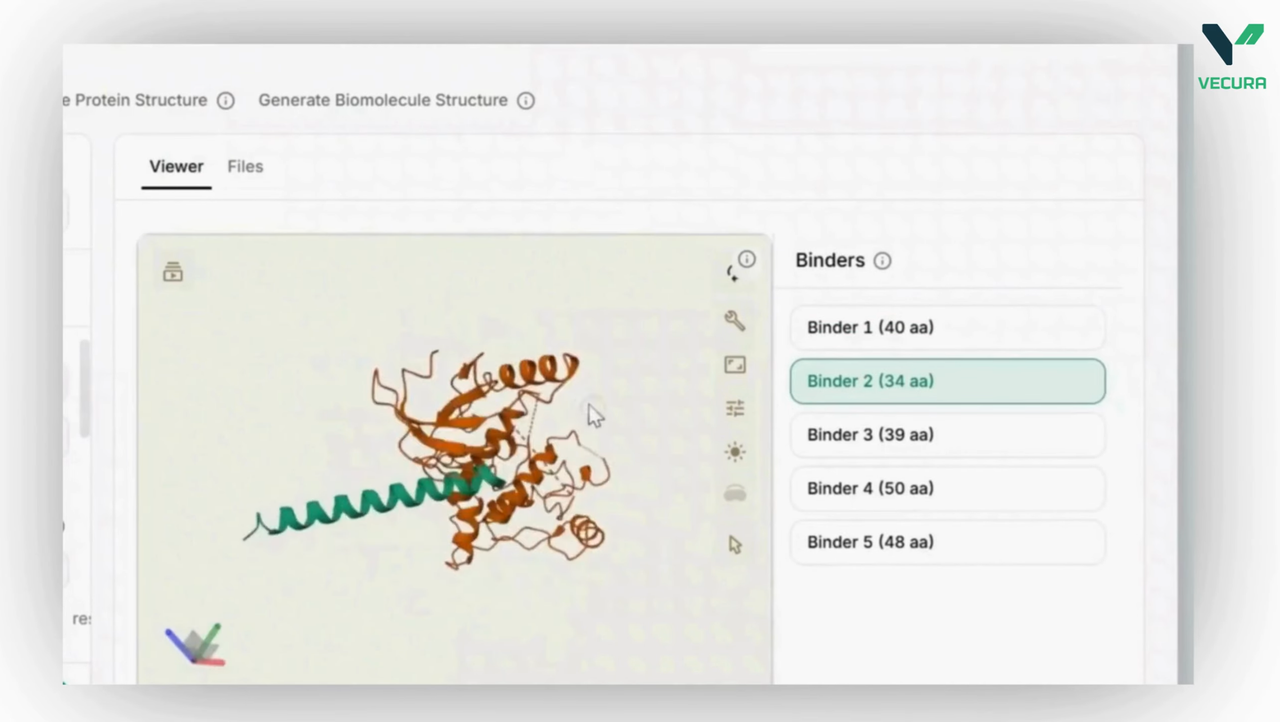
Design macrocyclic binders — Create cyclic peptides that simultaneously adopt a closed-ring geometry and dock against a target protein structure of interest, such as a receptor, enzyme, or protein-protein interaction interface.
-
Focus binding to hotspot residues — Specify target residues that the designed binder should contact, guiding the model toward functionally relevant binding sites on the target protein.
-
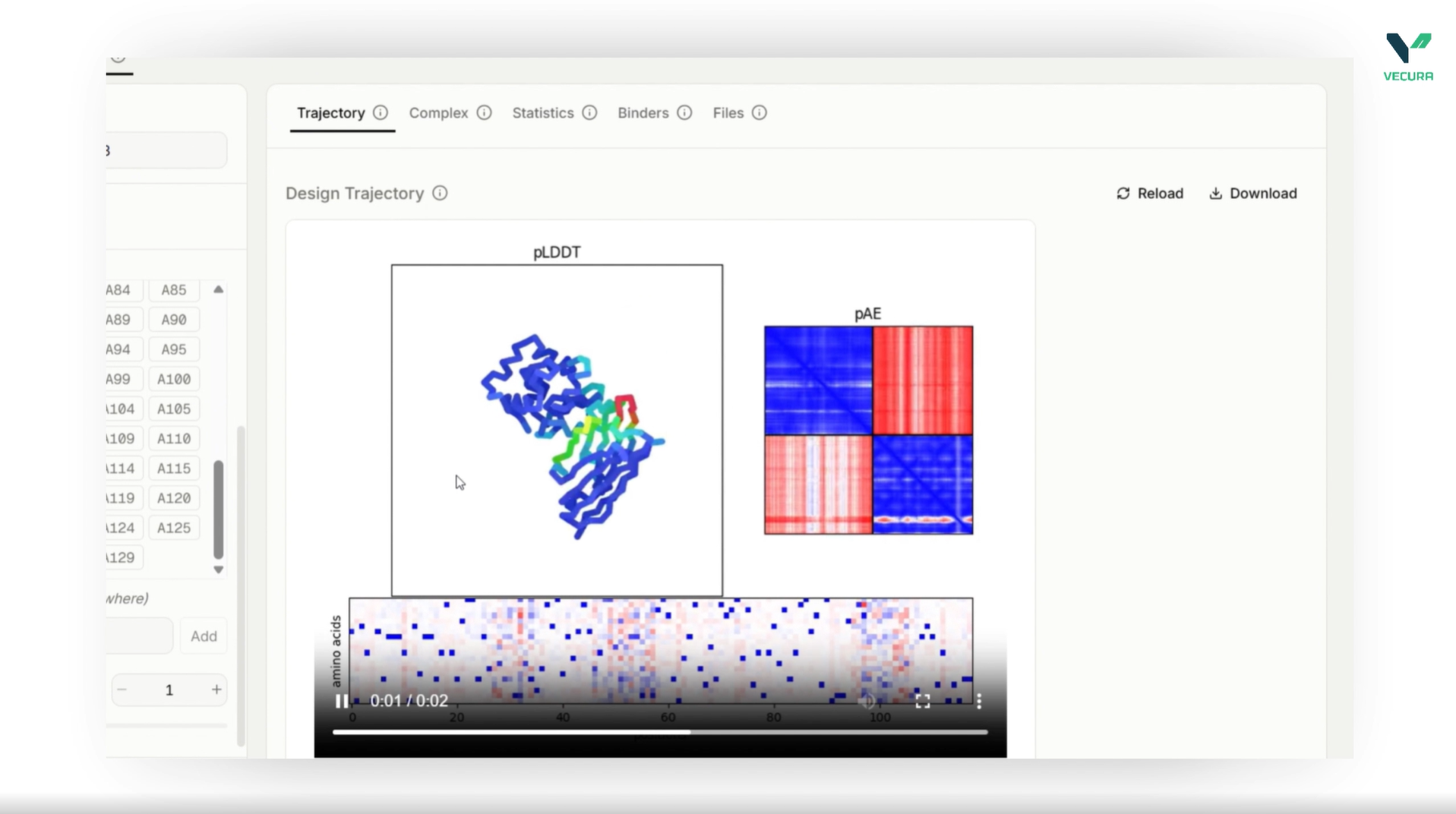
Visualize diffusion trajectories — Inspect the full denoising path of each design via pX0 predictions and Xt-1 trajectory files, enabling debugging and deeper understanding of how the cyclic backbone geometry emerges during the generative process.
What the output means
The output provides a designed macrocyclic peptide backbone in PDB format (glycine-only, backbone atoms only), along with parsed .trb metadata containing the exact contig configuration, residue-mapping arrays, and the full RFdiffusion Hydra configuration used. Optional trajectory files allow visualization of the denoising path in molecular viewers like PyMOL.
For binder designs, the output PDB includes both the cyclic peptide chain and the target protein chain for direct visualization of the designed complex. The .trb metadata maps input residue positions to output positions, enabling precise tracking of which residues were fixed versus generated.
This output should be used to support scientific decision making. It does not replace experimental validation. Downstream sequence design (e.g., via ProteinMPNN) and experimental binding assays are required to produce functional macrocyclic peptide therapeutics.
Why this matters
Macrocyclic peptides occupy a uniquely attractive space in drug discovery — they combine the target specificity of biologics with the cell permeability and oral bioavailability potential of small molecules. Their head-to-tail cyclized topology confers resistance to proteolytic degradation and often improves binding affinity by reducing conformational entropy. Despite these advantages, de novo design of protein-binding macrocycles has remained a longstanding challenge. Prior methods relied on grafting loops onto known cyclic scaffolds or required prohibitively large experimental screening campaigns via display technologies.
RFpeptides changes this paradigm. In published validation, the pipeline designed high-affinity binders against four diverse protein targets — MCL1, MDM2, GABARAP, and Rhombotarget A (RbtA) — testing only ~20 designs per target, orders of magnitude fewer than conventional display-based methods. Crystal structures of macrocycle–protein complexes matched computational models with Cα RMSD under 1.5 Å, demonstrating atomic-level accuracy. A standout binder against GABARAP achieved a Kd of 6 nM and an IC50 of 0.7 nM, while a binder against RbtA reached Kd < 10 nM — even when starting from a predicted rather than experimentally determined target structure. By making this technology accessible on Vecura, researchers can now incorporate generative macrocyclic peptide design into their discovery pipelines without the overhead of managing GPU clusters, RFdiffusion installations, or complex dependency chains.
-
Developed by: Rettie, Juergens, Adebomi et al. — Institute for Protein Design (IPD) and UW School of Pharmacy, University of Washington (Baker Lab / RosettaCommons)
-
Source: RFpeptides README on GitHub (rfpeptides branch) | RFdiffusion Repository — rfpeptides branch
-
Reference: Rettie, S.A., Juergens, D.A., Adebomi, V. et al. "Accurate de novo design of high-affinity protein-binding macrocycles using deep learning." Nature Chemical Biology (2025). https://www.nature.com/articles/s41589-025-01929-w
Try RFpeptides on Vecura.
Open the model workspace and start evaluating it with your own inputs.