ProteoCraft Is Now Available on Vecura
This update enables protein engineers, immunology researchers, and antibody developers to design and evaluate protein binders through a guided, AI-driven workflow inside Vecura, without setting up complex GPU infrastructure or managing deep learning pipelines.
What is ProteoCraft?
ProteoCraft is a computational protein-design tool that solves the binder problem: given a target protein, it proposes amino-acid sequences for a new binder and predicts how that binder sits against the target. It uses frozen ESMFold2 structure models combined with a frozen ESMC-6B protein language model to generate gradient-guided sequence proposals, then verifies every discrete candidate through full ESMFold2 complex predictions in a two-stage Monte Carlo tree search.
It helps users design novel protein binders from scratch, redesign existing antibody CDR loops, and create binders targeting T-cell receptors — all within a single, unified framework. It is especially useful for researchers who need to go from a target sequence to a ranked set of candidate binder designs with predicted complex structures and confidence metrics, without manually orchestrating multi-step deep learning pipelines.
What can users do with ProteoCraft on Vecura?
With ProteoCraft on Vecura, users can:
-
Design de novo protein binders against any target protein by providing the target sequence, desired binder length, and optional hotspot residues, and receive a ranked set of candidate binder sequences with predicted complex structures.
-
Generate TCR-targeting binders by uploading a T-cell receptor structure or providing alpha and beta chain sequences, enabling the design of binders against specific TCR-facing surfaces for immunotherapy research.
-
Redesign CDR loops or specific binder regions in existing antibodies and nanobodies while keeping the rest of the framework intact, using position intervals, sequence motifs, or custom mutable masks to define exactly which residues to optimize.
-
Rescore candidate binders with a frozen, independent evaluation protocol (20 loops, 200 sampling steps, three evaluation seeds) to obtain quotable and comparable interface scores across candidates from any source.
What the output means
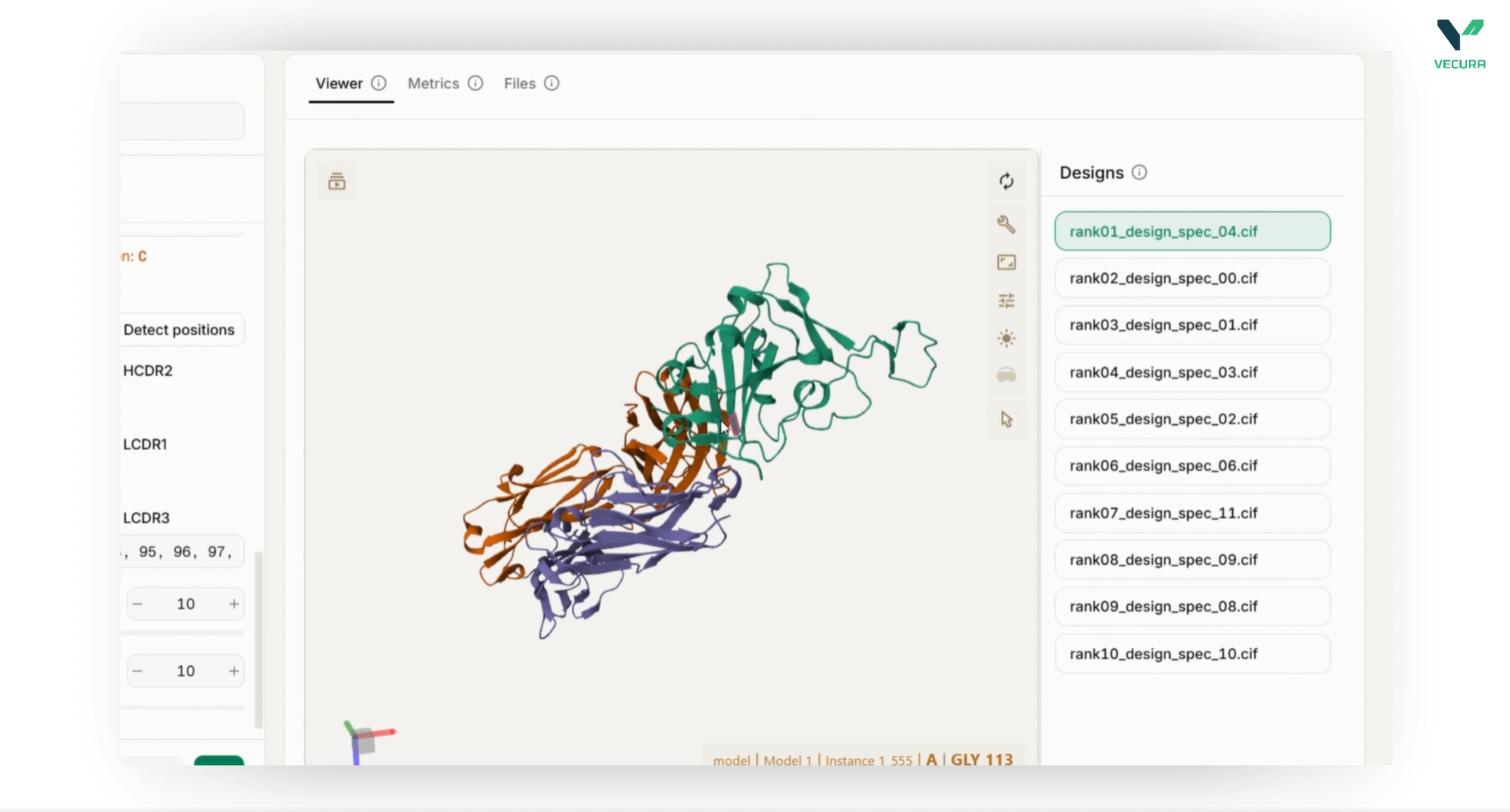
The output provides a selected binder sequence, a predicted mmCIF structure of the full target–binder complex, confidence metrics (pair-chain iPTM, pLDDT), a complete search trajectory showing how candidates were explored and verified, and independent rescoring scores across multiple evaluation seeds. Users also receive the full candidate list with per-candidate metrics, handoff checkpoints for resuming searches, and optional per-candidate structure files.
This output should be used to support scientific decision making. It does not replace experimental validation. The scores describe what the structure models predict — binding, specificity, and affinity must be measured in the laboratory, and a high computational score does not guarantee a functional binder.
Why this matters
Designing protein–protein interactions is one of the central challenges in biochemistry and drug development. Traditional approaches to binder design — whether structure-based docking, directed evolution, or phage display — are resource-intensive and often yield limited success rates. Recent advances in protein language models and structure prediction, particularly the ESM family developed by Biohub, have opened the door to fully computational design workflows. However, turning these models into a reliable design engine requires careful orchestration: gradients from diffusion-based structure predictors are approximate and cannot be trusted as direct value estimators, so a naive optimization loop can produce sequences that score well in gradient space but fail under full structure verification.
ProteoCraft addresses this gap by formalizing protein design as a proposal–verification search problem. The key insight is that approximate gradients are valuable for proposing discrete sequence edits, while expensive full-model inference should be reserved exclusively for verifying those candidates. The two-stage Monte Carlo tree search then allocates the limited verification budget intelligently — Stage A explores broadly from multiple starting points across diverse sequence regions, and Stage B refines the most promising candidates one residue at a time. This coarse-to-fine strategy has been shown to outperform compute-matched baselines on both ESMFold2 and AlphaFold2 evaluation metrics, including for challenging TCR-targeting design tasks. By making ProteoCraft available on Vecura, researchers can now access this sophisticated design pipeline through a managed interface, focusing on their biological questions rather than on GPU provisioning, model checkpoint management, and search parameter tuning.
-
Developed by: ProteoCraft contributors (built on Biohub's ESMFold2 and ESMC-6B models)
-
Source: Paper — ProteoCraft: Protein Design as Proposal–Verification Search (arXiv:2611.03963)
-
Reference: Official GitHub Repository | Task Examples (USAGE.md) | Algorithm Details (ALGORITHM.md)
Try ProteoCraft on Vecura.
Open the model workspace and start evaluating it with your own inputs.