PocketFlow Now Available on Vecura: AI-Powered Structure-Based Drug Design Made Accessible
This update enables medicinal chemists and computational biologists to generate novel, chemically valid drug candidates directly inside protein binding pockets through a guided, no-code workflow inside Vecura — without setting up complex technical infrastructure, GPU servers, or Python environments.

What is PocketFlow?
PocketFlow is a cutting-edge, structure-based molecular generative AI model that designs novel, drug-like ligand molecules from scratch — conditioned solely on the 3D geometry of a protein binding pocket. Unlike traditional ligand-based generative models, it incorporates explicit chemical knowledge (valence rules, bond-length constraints, ring-closure logic) directly into its autoregressive flow-matching architecture — ensuring 100% chemical validity out-of-the-box. It generates both canonical SMILES strings and full 3D atomic coordinates for each molecule, enabling immediate downstream use in docking, visualization, or SAR analysis.
It helps users rapidly explore uncharted chemical space around a target binding site. It is especially useful for early-stage hit identification, scaffold hopping, and generating tailored compounds when no known ligands exist — all while maintaining strict adherence to real-world chemical principles.
What can users do with PocketFlow on Vecura?
With PocketFlow on Vecura, users can:
-
Extract binding pockets from receptor-ligand complexes using the integrated
split_pocketutility — simply upload a receptor PDB and reference ligand SDF to auto-generate a pocket-optimized PDB file. -
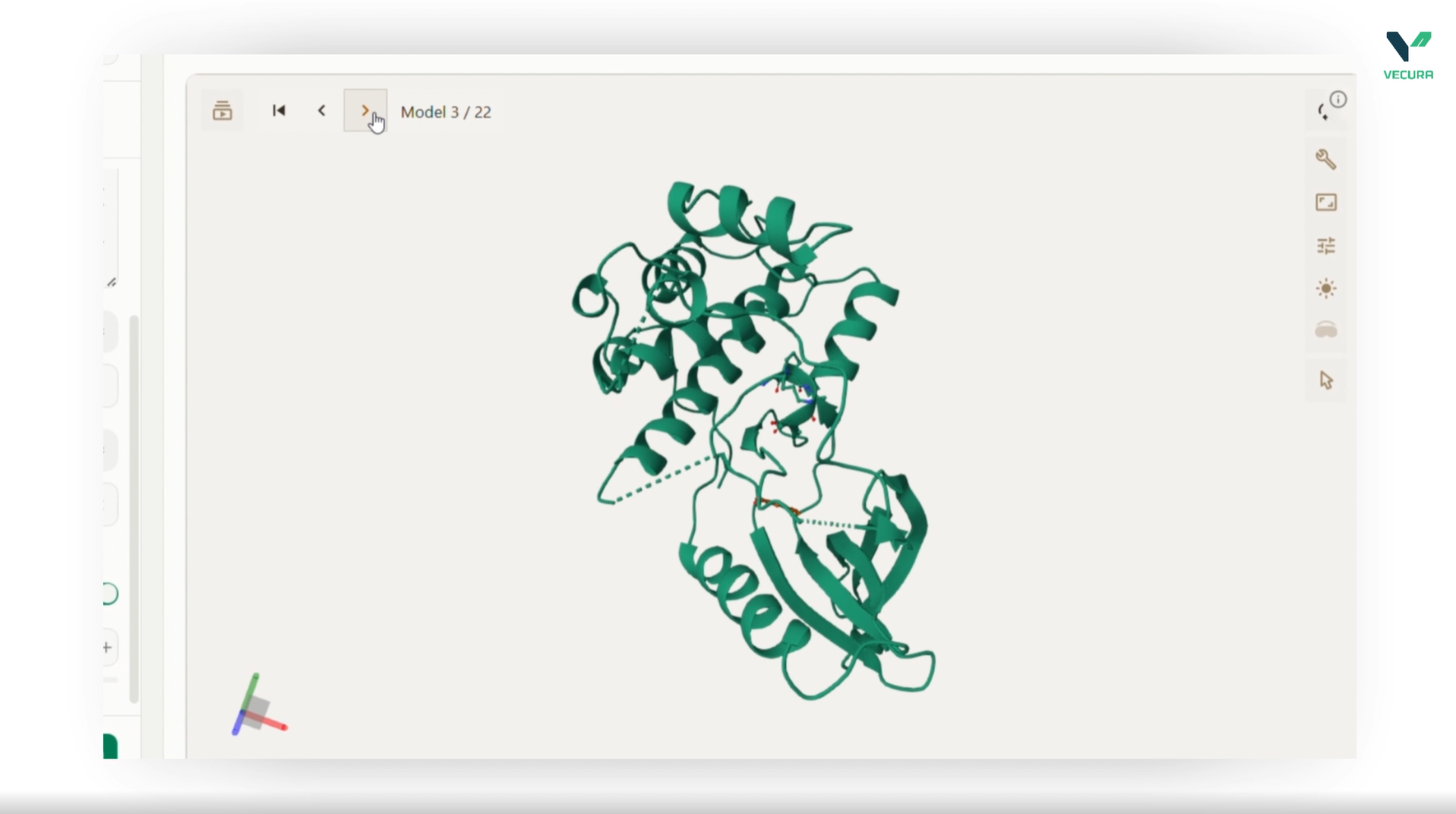
Generate novel ligands in seconds by uploading the pocket PDB — no initial scaffold required, no coding, no local installation.
-
Tune generation behavior via intuitive sliders and toggles: control molecule size (
max_atom_num), diversity (atom_temperature,bond_temperature), growth strategy (choose_max,focus_threshold), and structural constraints (bond_length_range,max_double_in_6ring). -
Download production-ready outputs, including ranked lists of canonical SMILES and fully formatted SDF files containing 3D poses aligned within the pocket — ready for docking rescoring, visualization in PyMOL/ChimeraX, or medicinal chemistry review.
What the output means
The output provides a ranked list of generated ligand molecules, each accompanied by a chemically valid SMILES string and a full 3D SDF block showing precise atomic coordinates inside the binding pocket. These are not abstract embeddings or scores — they are concrete, synthesizable molecular structures with realistic geometry.
This output should be used to support scientific decision making — prioritizing candidates for synthesis, docking, or expert review. It does not replace experimental validation (e.g., binding assays or crystallography), but dramatically accelerates hypothesis generation and reduces reliance on serendipity in early discovery.
Why this matters
Structure-based de novo design has long been hampered by low chemical validity, poor 3D geometry, and steep technical barriers — requiring expertise in deep learning, molecular simulation, and HPC infrastructure. PocketFlow bridges that gap by embedding domain-specific chemical intelligence directly into its generative process, eliminating the need for costly post-hoc filtering and enabling reliable, interpretable outputs from the first run.
Its integration into Vecura democratizes access to state-of-the-art AI for drug discovery — empowering teams without dedicated ML engineers or GPU clusters to leverage the same methodology published in Nature Machine Intelligence. In an era where speed-to-hit and chemical tractability define project success, PocketFlow shifts the bottleneck from computation to biological insight — accelerating the path from target to validated lead.
-
Developed by: Saoge Jiang, Yifan Zhang, and research team (affiliated with academic institutions and open science initiatives)
-
Reference: Jiang, S., Zhang, Y. et al. PocketFlow: a data-and-knowledge-driven structure-based molecular generative model. Nat Mach Intell 6, 578–591 (2024). https://doi.org/10.1038/s42256-024-00808-8
Try PocketFlow on Vecura.
Open the model workspace and start evaluating it with your own inputs.