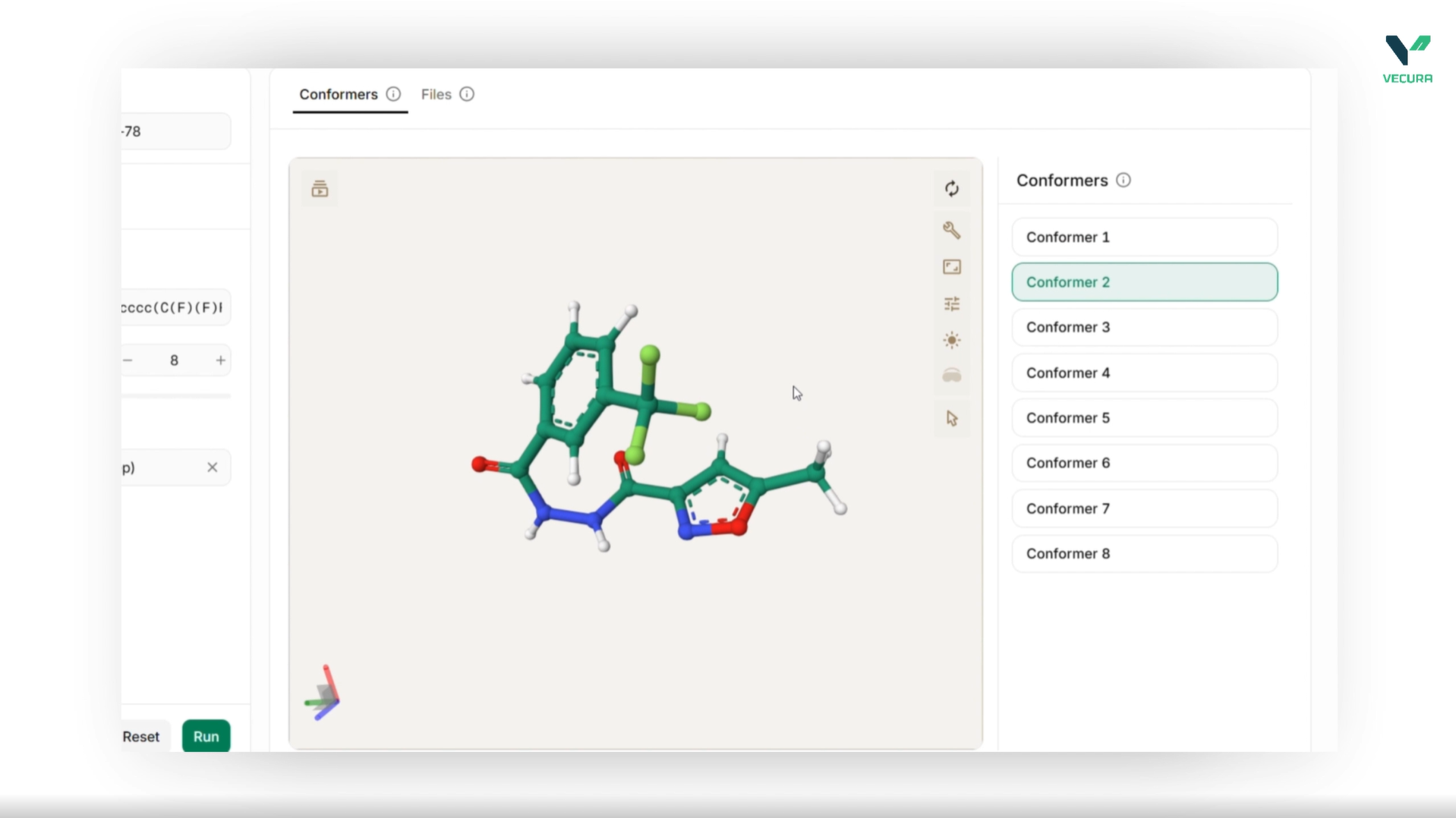
LoQI is now available on Vecura
This update enables computational chemists and drug discovery researchers to generate physically realistic 3D molecular conformers through a guided workflow inside Vecura, without setting up complex technical infrastructure.
What is LoQI?
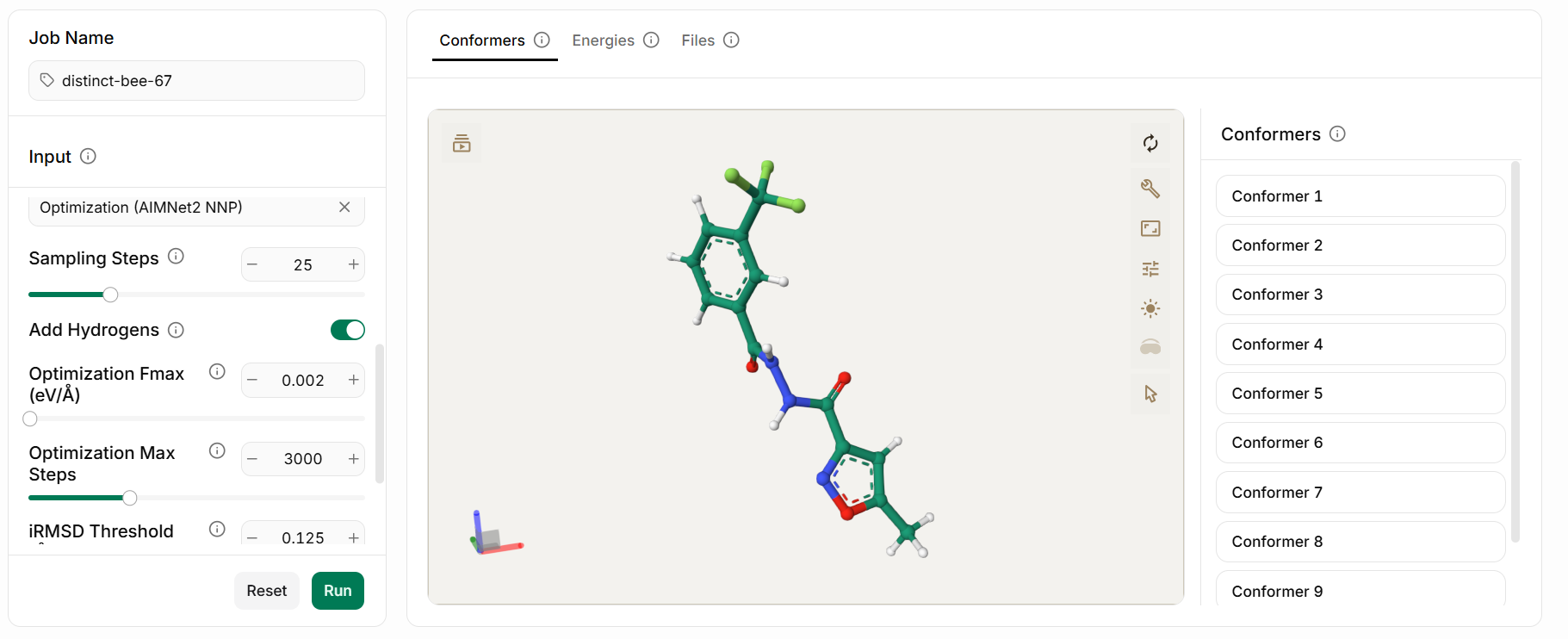
LoQI (Low-energy QM Informed) is a stereochemistry-aware diffusion and flow-matching model that generates 3D molecular conformers from 2D structures with near-quantum-mechanical accuracy. It takes a SMILES string or SDF file as input and produces multiple low-energy 3D geometries while preserving stereochemical details like R/S tetrahedral centers and E/Z double bonds.
It helps users rapidly enumerate physically realistic 3D conformers for drug-like molecules, replacing expensive classical force field or DFT calculations. It is especially useful for molecular docking, pharmacophore modeling, and building conformer ensembles for QSAR/ADMET pipelines.
What can users do with LoQI on Vecura?
With LoQI on Vecura, users can:
-
Generate multiple 3D conformers from a SMILES string or SDF file
-
Choose between diffusion (fixed 25 steps) or flow-matching (1-100 tunable steps) generative backends
-
Optionally refine geometries with AIMNet2 neural network potential optimization
-
Prune conformers to a structurally unique set using interatomic RMSD clustering
-
Obtain energy-ranked conformers with relative energy values in kcal/mol
-
Validate stereochemistry and topology preservation in generated structures
What the output means
The output provides a multi-conformer SDF file containing all generated 3D structures, along with relative energies (when optimization is enabled), topology preservation metrics, stereochemistry preservation metrics, and generation timing information.
This output should be used to support scientific decision making. It does not replace experimental validation.
Why this matters
Enumerating low-energy 3D conformers is a fundamental bottleneck in computational chemistry and drug discovery. Traditional approaches using classical force fields or density functional theory (DFT) are computationally expensive, while prior generative models often produce physically implausible geometries or fail to preserve subtle stereochemical details. LoQI addresses this by training on ChEMBL3D—a dataset of 250+ million AIMNet2-optimized conformers spanning 1.8 million drug-like compounds—achieving up to tenfold improvement in energy accuracy over prior generative conformer methods.
The model's explicit stereochemical encoding makes it the first all-atom diffusion model to maintain near-perfect stereochemistry preservation, validated on challenging cases including macrocycles, flexible molecules, and crystal structures. This capability enables researchers to rapidly generate high-quality conformer ensembles that would otherwise require days of computation, accelerating downstream tasks from virtual screening to ADMET prediction.
-
Developed by: Filipp Nikitin (Isayev Lab)
-
Source: GitHub repository
-
Reference: Megalodon architecture paper (arXiv:2505.18392), ChEMBL3D dataset
Try LoQI on Vecura.
Open the model workspace and start evaluating it with your own inputs.