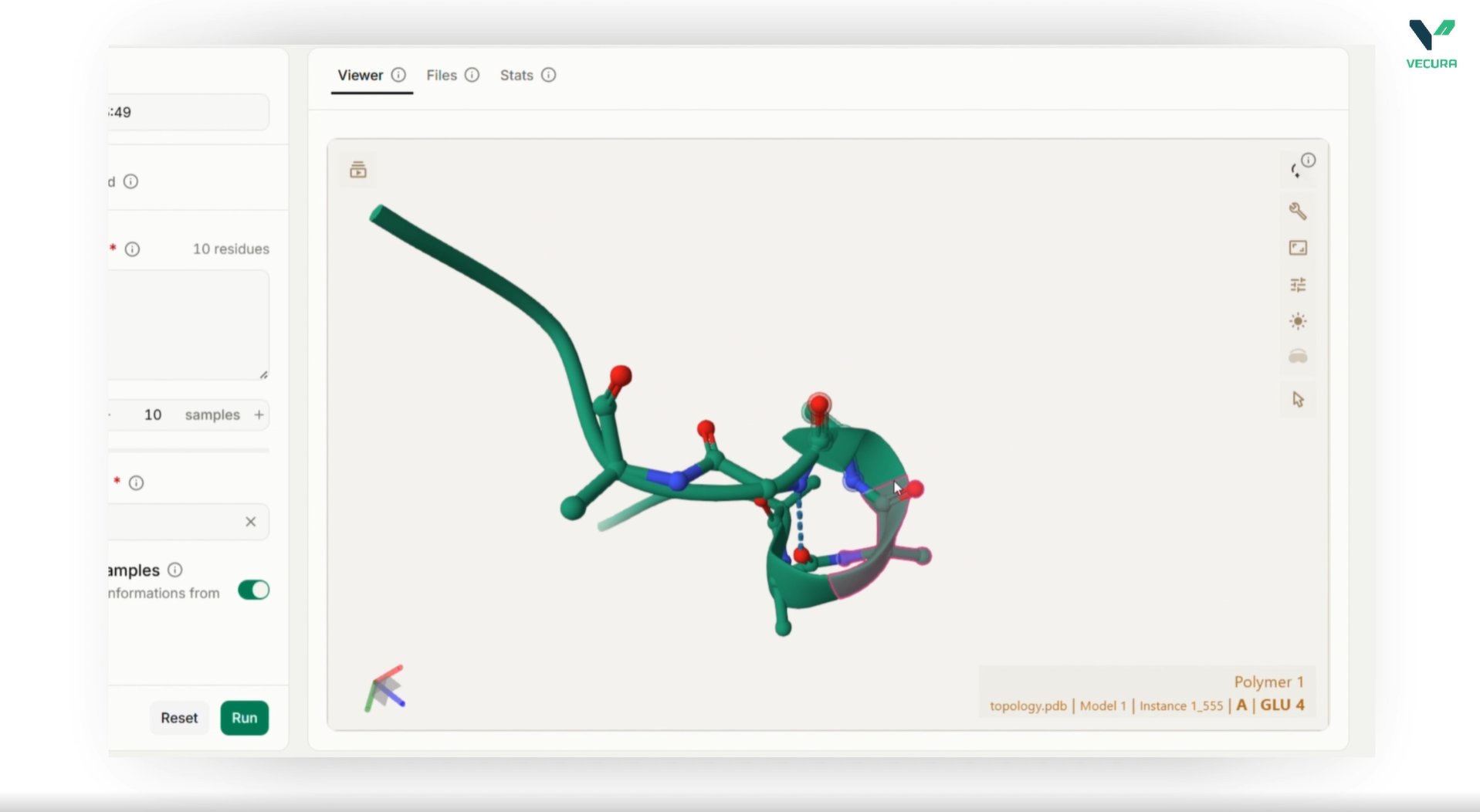
EVcouplings Is Now Available on Vecura
This update enables structural biologists, protein engineers, and computational biologists to predict protein contacts, assess mutation effects, and generate 3D structure models through a guided coevolutionary analysis workflow inside Vecura — without setting up complex computational infrastructure or managing large sequence databases.

What is EVcouplings?
EVcouplings is a Python framework for coevolutionary sequence analysis developed by the Marks lab at Harvard. It predicts protein structure, function, and the effects of mutations by analyzing evolutionary sequence covariation — the correlated patterns of amino acid substitutions that accumulate across a protein family over millions of years of evolution. Starting from a single protein sequence, the framework builds a deep multiple sequence alignment, infers pairwise residue-residue evolutionary couplings using pseudolikelihood maximisation (plmc), and uses these couplings to predict structural contacts, score mutations, and generate de novo 3D structure models.
It helps users extract rich structural and functional information directly from sequence data alone — no experimental structure or labelled training data required. It is especially useful for studying proteins with no known homologous structures, engineering protein variants with desired mutation profiles, and exploring inter-residue contacts in protein complexes.
What can users do with EVcouplings on Vecura?
With EVcouplings on Vecura, users can:
-
Predict residue-residue contacts from evolutionary couplings, identifying which amino acid pairs are likely in physical proximity in the folded protein — complete with probabilistic scoring that dramatically reduces false positives.
-
Score the fitness effects of mutations using the EVmutation epistatic model, which leverages the full coupling parameter set to predict whether any single or multi-site substitution is likely beneficial or deleterious — without requiring labelled training data.
-
Generate de novo 3D structure models by feeding high-confidence evolutionary couplings as distance restraints into CNSsolve-based simulated annealing, producing ranked structural models directly from sequence.
-
Analyze protein complexes by pairing monomer alignments through best-reciprocal-ortholog species matching, enabling inter-chain contact prediction and docking restraint generation for multi-protein assemblies.
What the output means
The output provides a comprehensive suite of results including: ranked evolutionary coupling pairs with Frobenius norm scores, APC-corrected norms, and mixture-model probabilities (higher probability = stronger contact evidence); a full single-mutant effect matrix with predicted ΔE log-odds scores for every position-amino acid substitution; de novo 3D PDB structure models ranked by restraint satisfaction and energy; contact map visualisations overlaying predicted couplings against known PDB contacts; and per-model TM-score and RMSD comparisons against experimental structures when available.
This output should be used to support scientific decision making. It does not replace experimental validation.
Why this matters
Protein structure and function prediction have long depended on computationally expensive physics-based simulations or template-based homology modelling that fails when no structurally similar protein is known. Coevolutionary analysis offers a fundamentally different approach: by treating the evolutionary record of a protein family as a natural experiment, methods like EVcouplings extract constraints that reflect the physical and functional requirements that shaped each protein over billions of years of divergent evolution. The introduction of probabilistic scoring via logistic-regression mixture models and the EVmutation epistatic fitness model represented significant advances in reducing false-positive contact predictions and enabling quantitative mutation effect prediction without supervised learning.
The availability of EVcouplings on Vecura brings this powerful but technically demanding pipeline — which traditionally required managing ~89 GB sequence databases, CNSsolve licensing, SIFTS mapping tables, and careful orchestration of six sequential analysis stages — to a broader audience of researchers. This is particularly impactful for groups studying understudied protein families, designing focused mutagenesis libraries for directed evolution experiments, or investigating inter-protein interactions in complexes where experimental structural data is sparse.
-
Developed by: Marks Lab (Debbie Marks' group) at Harvard Medical School, with contributions from Thomas Hopf, Anna Green, and the Sander Lab
-
Source: GitHub Repository | Documentation
-
Reference: Hopf et al., "The EVcouplings Python framework for coevolutionary sequence analysis," Bioinformatics 35(9), 2019. DOI: 10.1093/bioinformatics/bty862
Try EVcouplings on Vecura.
Open the model workspace and start evaluating it with your own inputs.