DockQ Is Now Available on Vecura
This update enables structural biologists and computational researchers to evaluate the quality of biomolecular docking predictions through a guided workflow inside Vecura, without setting up complex technical infrastructure or managing local dependencies.
What is DockQ?
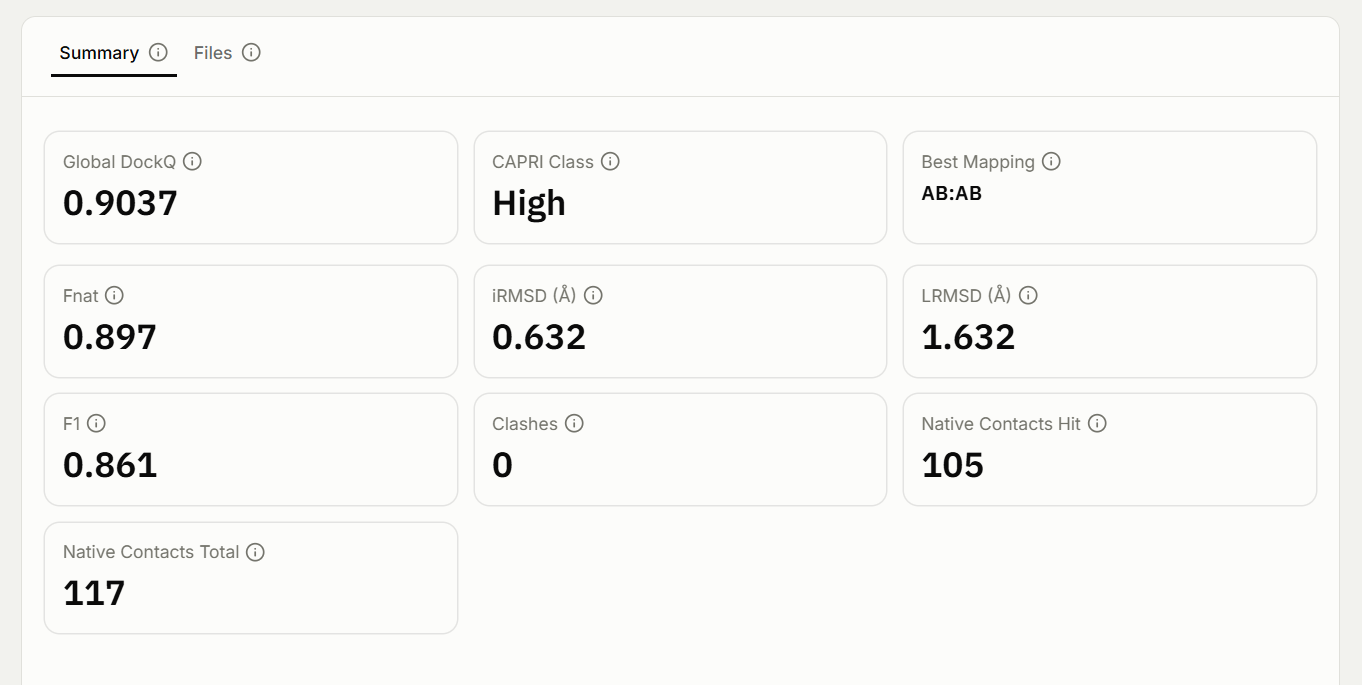
DockQ is the de-facto community standard for measuring the quality of biomolecular docking predictions against a known native reference structure. Given a predicted complex and an experimental reference, it computes a comprehensive battery of per-interface metrics—including DockQ score, interface RMSD (iRMSD), ligand RMSD (LRMSD), fraction of native contacts (fnat), fraction of non-native contacts (fnonnat), F1 score, and clashes—and aggregates them into a single score between 0 and 1. DockQ v2 extends support beyond protein dimers to handle protein–protein, protein–nucleic-acid, nucleic-acid–nucleic-acid, and protein–small-molecule complexes, with automatic exhaustive chain-mapping optimisation.
It helps users quantitatively assess how closely a predicted biomolecular complex matches an experimental reference structure. It is especially useful for benchmarking docking and co-folding methods such as AlphaFold-Multimer, Rosetta Dock, and HADDOCK, and is the primary quality measure used in CAPRI and CASP-multimer assessments.
What can users do with DockQ on Vecura?
With DockQ on Vecura, users can:
-
Evaluate predicted protein–protein, protein–nucleic-acid, and nucleic-acid–nucleic-acid docking models against native reference structures
-
Automatically identify optimal chain mappings between predicted and native complexes without manual alignment
-
Assess small-molecule docking poses with a dedicated LRMSD evaluation mode
-
Obtain per-interface breakdowns of DockQ score, iRMSD, LRMSD, fnat, fnonnat, F1, and clash counts to pinpoint which specific contacts are preserved or lost
What the output means
The output provides an aggregate DockQ score (ranging from 0 to 1), the optimal chain mapping between model and native structures, and a detailed per-interface breakdown including DockQ, iRMSD, LRMSD, fnat, fnonnat, F1, and clash counts. DockQ scores below 0.23 indicate incorrect predictions, while scores ≥ 0.23, ≥ 0.49, and ≥ 0.80 correspond to Acceptable, Medium, and High quality predictions, respectively.
This output should be used to support scientific decision making. It does not replace experimental validation.
Why this matters
Biomolecular docking predictions are central to drug discovery, protein engineering, and understanding cellular signaling pathways. With the rapid proliferation of AI-driven structure prediction tools like AlphaFold-Multimer, researchers need standardized, reproducible quality measures to compare predictions across methods and datasets. DockQ provides exactly that—a single, well-validated metric that the structural biology community has adopted as the gold standard for docking assessment, widely used in CAPRI and CASP-multimer evaluations.
By making DockQ available through Vecura's guided workflow, researchers can seamlessly integrate standardized quality assessment into their computational pipelines without managing local installations, dependency conflicts, or complex chain-mapping configurations. This lowers the barrier to reproducible benchmarking and ensures that docking predictions are evaluated against community-accepted standards before advancing to costly experimental validation.
-
Developed by: Wallner Lab (Björn Wallner group, Linköping University)
-
Source: Official GitHub repository
-
Reference: Mirabello & Wallner, Bioinformatics 2024; Basu & Wallner, PLOS ONE 2016
Try DockQ on Vecura.
Open the model workspace and start evaluating it with your own inputs.