Vecura Biotech Insiders #03: Building a Humanized Tyrosinase Model for Structure-Based Docking
In this Vecura Biotech Insiders feature, we explore a user-shared workflow for building a copper-tagged human tyrosinase model from AlphaFold, benchmarking it against mushroom tyrosinase, and preparing it for structure-based docking.
A User-Shared Workflow from the Vecura Community
In structure-based discovery, the quality of the target model can shape every result that follows.
For some targets, researchers can start from a high-resolution experimental structure. For others, especially human proteins without available crystal or cryo-EM structures, the first challenge is building a model that is biologically meaningful enough to support downstream analysis.
In this third edition of Vecura Biotech Insiders, we highlight a workflow shared with the Vecura team by Thanh Tran during the support process.
The workflow focuses on human tyrosinase, or TYR, a copper-dependent enzyme involved in melanin biosynthesis. Human TYR is pharmacologically important, but according to the user-shared workflow, it does not yet have an experimental crystal structure available in the Protein Data Bank. As a result, many published inhibitor screening workflows rely on mushroom tyrosinase as a surrogate model.
Thanh's workflow takes a different route: starting from the AlphaFold model of human TYR, transplanting the catalytic copper ions from the mushroom tyrosinase structure, preparing the copper-tagged system, and validating the model through docking of a small compound panel.
The goal is not to claim that this model replaces experimental structure determination. The goal is to show how a careful computational workflow can create a more human-relevant structural basis for tyrosinase docking.
Research Context: Why the Human Target Matters
Tyrosinase is a key enzyme in melanin biosynthesis. It catalyzes the hydroxylation of L-tyrosine to L-DOPA and the oxidation of L-DOPA to dopaquinone, a rate-limiting step in melanin formation.
Human TYR is associated with several biological and medical contexts:
| Context | Relevance |
|---|---|
| Hyperpigmentation | TYR is a validated target for hyperpigmentation-related drug discovery |
| Oculocutaneous albinism type 1 | Loss-of-function mutations in TYR are linked to OCA1 |
| Melanoma biology | TYR is expressed in melanoma cells and can act as a tumor-associated antigen |
| Cosmetic and dermatological research | TYR inhibition is widely studied for pigmentation modulation |
However, the structural biology presents a challenge.
The workflow notes that human TYR does not currently have an experimental X-ray or cryo-EM structure in the Protein Data Bank. Because of this, many studies use Agaricus bisporus mushroom tyrosinase or polyphenol oxidase structures as a surrogate.
That surrogate is useful, but imperfect. The workflow highlights several reasons why mushroom tyrosinase may not fully represent the human ortholog:
| Limitation of Mushroom Surrogate | Why It Matters |
|---|---|
| Low sequence identity to human TYR | Docking results may not transfer reliably |
| Different substrate-access channel geometry | Ligands may enter and bind differently |
| Non-conserved gatekeeper residues | Active-site accessibility and inhibitor behavior may differ |
| Structural and enzymological divergence | SAR from mushroom TYR may not reflect human TYR |
This is why a humanized model is useful for structure-based docking.
Workflow Overview: From AlphaFold to Copper-Tagged Human TYR
The workflow followed a staged modeling and validation path:
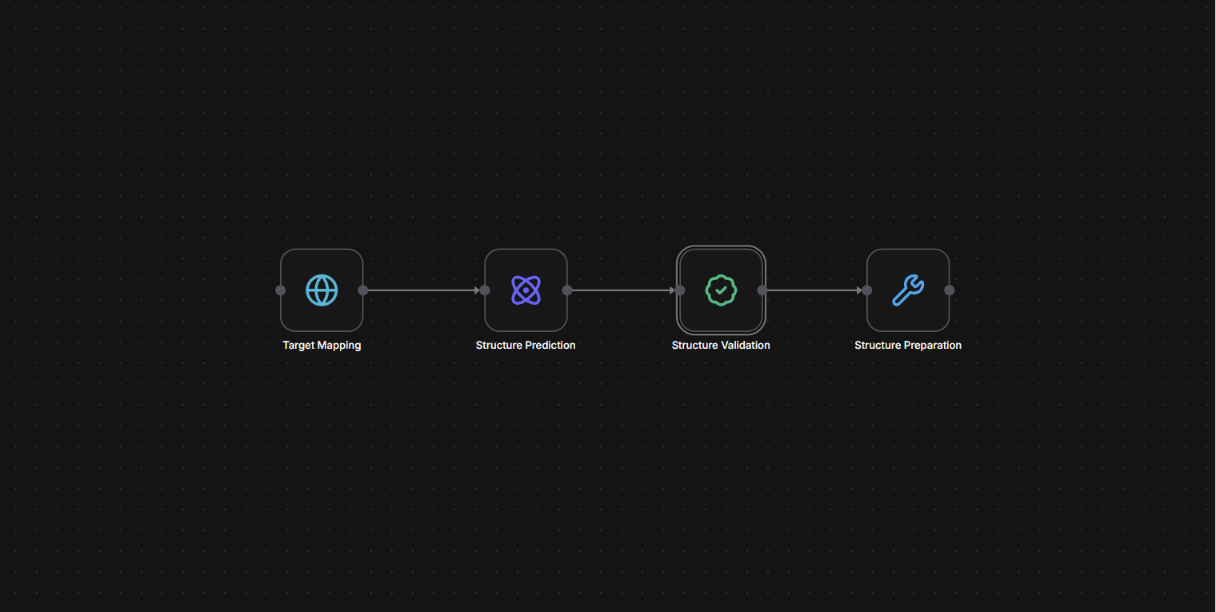
Figure 1. Workflow template showing target mapping, structure prediction, structure validation, and structure preparation.
| Stage | Workflow Step | Purpose |
|---|---|---|
| 0 | Sequence and domain framing | Define the modeled TYR region and active-site residues |
| 1 | Structure acquisition and confidence audit | Fetch the human AlphaFold model and mushroom reference structures |
| 2 | Structural alignment and humanization audit | Superimpose human TYR model onto mushroom TYR/PPO3 reference |
| 3 | Copper tagging by structural transplant | Place CuA and CuB into the human TYR model |
| 4 | System preparation and energy minimization | Prepare the copper-tagged system in OpenMM |
| 5 | Equilibration and production MD | Benchmark active-site stability through molecular dynamics |
| 6 | Docking validation | Dock a six-compound panel using gnina |
| 7-8 | Results interpretation and limitations | Evaluate model quality, docking behavior, and scope boundaries |
This workflow shows how the target model itself becomes part of the scientific work. Before docking inhibitors, the user first built and audited the receptor model.
Tools and Structures Used in the Workflow
| Tool / Structure | Role in This Workflow |
|---|---|
| UniProt P14679 | Human tyrosinase sequence reference |
| AlphaFold AF-P14679-F1 | Starting structure model for human TYR |
| PDB 2Y9X | Mushroom tyrosinase/PPO3 tropolone-bound reference with copper ions |
| PDB 2Y9W | Mushroom deoxy reference structure without tropolone |
| OpenMM | System preparation, minimization, and MD workflow |
| gnina | Docking with Vina scoring and CNN rescoring |
| Vecura | Unified environment for connecting structure preparation, validation, and docking steps |
The key methodological move was copper tagging. AlphaFold does not provide metal ions in the model, but TYR requires a binuclear copper center for catalytic relevance. The workflow solved this by transplanting CuA and CuB coordinates from the aligned mushroom structure into the human AlphaFold model.
Stage 0: Defining the Human TYR Model
Before any docking or simulation, the workflow first framed the TYR sequence and domain architecture.
Human TYR, based on the workflow, is a 529-amino-acid type-I membrane glycoprotein. For modeling and docking, the workflow focused on the luminal catalytic domain.
| Segment | Residues | Modeling Decision |
|---|---|---|
| Signal peptide | 1-18 | Cleaved; not modeled |
| Luminal catalytic domain | 19-476 | Main modeling and docking target |
| Transmembrane helix | 477-497 | Omitted from soluble model |
| Cytoplasmic tail | 498-529 | Omitted |
The active site was defined by six histidines coordinating two copper ions:
| Copper Ion | Coordinating Human Histidines |
|---|---|
| CuA | His180, His202, His211 |
| CuB | His363, His367, His390 |
This active-site definition became the anchor for the rest of the workflow.
Stage 1-2: Auditing the AlphaFold Model Against Mushroom TYR
The workflow then fetched the AlphaFold model of human TYR and compared it against the mushroom tyrosinase/PPO3 reference structure.
The human catalytic domain was superimposed onto the equivalent catalytic domain of PDB 2Y9X. This allowed the user to inspect whether the AlphaFold backbone placed the six copper-coordinating histidines in a geometry compatible with the type-3 copper center.
This step also helped identify differences in the substrate-access channel, including gatekeeper residue divergence between mushroom and human TYR. This matters because active-site access can influence docking behavior.
In other words, this stage was not only about aligning two structures. It was about asking whether the human AlphaFold model could be made chemically meaningful for docking.
Stage 3: Copper Tagging by Structural Transplant
This was the methodological core of the workflow.
The user transplanted the two copper ions from PDB 2Y9X into the aligned human TYR model. The workflow applied the same rigid transformation used in the structure alignment to place CuA and CuB into the human active site.
After copper placement, the geometry was checked against expected coordination ranges.
| Geometry Check | Reported Value / Expected Range |
|---|---|
| Cu-Nε2 bond lengths | Expected around 2.0-2.2 Å |
| Cu···Cu distance | Expected around 3.5-4.9 Å depending on oxidation state |
| 2Y9X reference Cu···Cu distance | 4.36 Å |
| Transplanted model Cu···Cu distance | 4.537 Å |
The workflow reported the following model quality values:
| Metric | Reported Value |
|---|---|
| Active-site mean pLDDT | 98.62 |
| Cα RMSD, catalytic domain post-alignment | 0.430 Å |
| Cu-Cu distance, transplanted model | 4.537 Å |
| CuA-His180 Nε2 | 2.149 Å |
| CuA-His202 Nε2 | 2.104 Å |
| CuA-His211 Nε2 | 2.196 Å |
| CuB-His363 Nε2 | 2.122 Å |
| CuB-His367 Nε2 | 2.100 Å |
| CuB-His390 Nε2 | 2.049 Å |
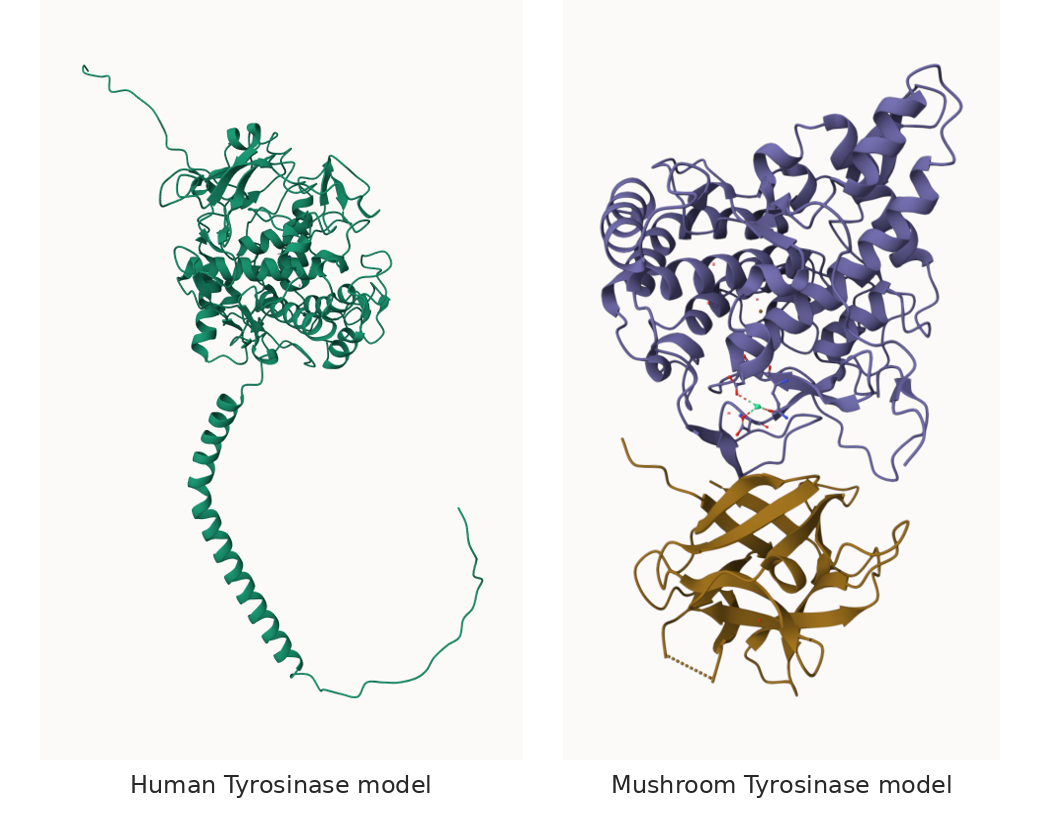
Figure 2. Human Tyrosinase model (left) and Mushroom Tyrosinase model (right).
These values suggest that the transplanted metal geometry was internally consistent in this workflow, although the model remains computational and should not be treated as experimentally resolved.
Stage 4-5: Preparing and Benchmarking the System
After copper tagging, the system was prepared in OpenMM.
The workflow described solvation in a TIP3P water box, ion addition to neutralize charge and approximate physiological ionic strength, AMBER ff14SB for the protein, and custom bonded parameters for the Cu-His cage.
Energy minimization was performed in staged cycles with tapering positional restraints:
| Minimization Cycle | Restraint Strategy |
|---|---|
| 1 | Heavy restraint on all non-hydrogen atoms while water relaxes |
| 2 | Backbone-only restraint while side chains relax |
| 3 | Restraint retained only on Cu and coordinating Nε2 atoms |
The goal was to relieve structural strain while preventing distortion of the metal-binding cage.
The workflow also described an optional or planned MD benchmarking stage. During MD, the key tracked signals included:
| MD Signal | Why It Matters |
|---|---|
| Backbone RMSD | Measures structural stability relative to the minimized start |
| Per-residue RMSF | Highlights flexible regions, especially active-site loops |
| Cu-Nε2 distance distribution | Checks stability of copper coordination |
| Substrate-channel width | Monitors channel geometry over time |
Running the same protocol on the mushroom reference system provides a benchmark for whether the copper-tagged human model behaves reasonably relative to a crystallographically characterized structure.
Stage 6: Docking Validation with a Six-Compound Panel
The workflow then used gnina for docking validation, combining Vina scoring with CNN-derived rescoring.
Instead of centering the docking box on the tropolone ligand, the workflow centered it on the midpoint of the two copper ions. This was intentional, because the copper center defines the catalytic site.
| Docking Setup | Direction |
|---|---|
| Docking tool | gnina |
| Scoring | Vina score, CNNaffinity, CNNscore |
| Box center | Cu-Cu centroid |
| Box size | 25 × 25 × 25 Å |
| Benchmarking | Same box dimensions re-centered on mushroom 2Y9X Cu-Cu midpoint |
The compound panel included natural substrates and known TYR inhibitors:
| Compound | Role in Panel |
|---|---|
| L-Tyrosine | Natural substrate |
| L-DOPA | Intermediate substrate / product |
| Kojic acid | Known TYR inhibitor; Cu chelator |
| Arbutin | Known TYR inhibitor; competitive |
| Hydroquinone | Known TYR inhibitor; competitive |
| Phenylthiourea | Classic TYR inhibitor; Cu chelator |
The reported human TYR docking outputs were:
| Ligand | Role | Vina (kcal/mol) | CNN score | CNN Affinity | Min Distance to Binuclear Copper |
|---|---|---|---|---|---|
| L-Tyrosine | Substrate | -6.430 | 0.892 | 3.888 | 3.62 |
| L-DOPA | Substrate | -5.960 | 0.791 | 4.365 | 3.73 |
| Kojic acid | Inhibitor; Cu chelator | -4.440 | 0.564 | 3.530 | 3.21 |
| Arbutin | Inhibitor; competitive | -7.340 | 0.483 | 3.915 | 2.97 |
| Hydroquinone | Inhibitor; competitive | -4.510 | 0.680 | 3.071 | 3.05 |
| Phenylthiourea | Inhibitor; Cu chelator | -4.890 | 0.878 | 3.961 | 2.94 |
The workflow emphasized that these scores should be interpreted carefully. Substrates may not top the Vina ranking because Vina scores can favor molecular size and hydrophobic contacts. Cu-chelating inhibitors may also be under-scored because classical docking functions may not fully capture direct copper coordination.
What This Workflow Demonstrates
This workflow demonstrates three important lessons for structure-based modeling and docking.
| Lesson | What It Means |
|---|---|
| The receptor model matters | Docking quality depends on whether the target model captures biologically relevant active-site features |
| AlphaFold models may need biochemical completion | For metalloproteins, missing ions can make a raw model chemically incomplete |
| Docking scores are not enough | Pose plausibility, metal distance, mechanism, and limitations must be considered together |
The key insight is that the workflow does not begin with docking. It begins with target preparation.
For human tyrosinase, that means defining the catalytic domain, auditing AlphaFold confidence, transplanting the binuclear copper center, minimizing the system, benchmarking its geometry, and only then docking ligands.
Why Vecura Helps
For structure-based workflows, researchers often need to connect multiple steps across different tools and assumptions. Each step can affect the reliability of the final docking result.
Vecura helps reduce this friction by supporting connected workflows where users can move from target mapping to structure prediction, validation, preparation, simulation, and docking.
| Traditional Workflow Challenge | How Vecura Helps |
|---|---|
| Human target lacks experimental structure | Supports workflows that start from predicted structures and reference templates |
| Metalloprotein models may be chemically incomplete | Helps users inspect and prepare models before docking |
| Surrogate structures may mislead SAR interpretation | Enables more human-relevant modeling workflows |
| Docking setup choices can bias results | Encourages transparent box definition and validation logic |
| Scores can be over-interpreted | Supports multi-metric review and explicit limitations |
The value of Vecura in this workflow is not a single docking score. It is the ability to organize a defensible modeling path from a human protein sequence to a copper-tagged receptor model and docking-ready workflow.
A Note on Scientific Interpretation
This workflow is computational and should be interpreted as an exploratory in-silico modeling workflow, not as an experimentally validated human TYR structure.
The copper ions were transplanted from a mushroom reference structure rather than experimentally observed in human TYR. The copper model uses fixed-charge or dummy-atom approximations and cannot fully capture type-3 di-copper redox chemistry. Docking scores from gnina should not be read as absolute binding affinities, Kd values, or IC50 values.
The workflow also omits glycosylation, the transmembrane anchor, and the melanosomal membrane context. These omissions may be acceptable for active-site docking exploration, but they matter for full-length enzyme behavior and folding biology.
The value of this workflow lies in its transparency: it makes the modeling assumptions visible and provides a structured path for benchmarking, docking, and further validation.
Where the Workflow Goes Next
The workflow suggests several next steps for further validation and refinement:
| Next Step | Purpose |
|---|---|
| Complete MD benchmarking | Evaluate active-site and copper coordination stability over time |
| Use ensemble docking | Reduce dependence on a single static AlphaFold conformer |
| Validate docking with positive controls | Check pose plausibility and known inhibitor behavior |
| Consider QM/MM for chelating inhibitors | Better capture copper coordination energetics |
| Add glycosylation and membrane context if needed | Improve biological realism for full-length TYR modeling |
Until an experimental human TYR structure becomes available, a carefully copper-tagged and transparently caveated AlphaFold-based model can provide a practical structural basis for human TYR-targeted docking.
Try Structure-Based Docking Workflows on Vecura
Thanh's workflow highlights a practical principle for structure-based discovery:
Do not start docking too early.
Prepare the target.
Check the active site.
Account for missing cofactors.
Benchmark the model.
Interpret scores with mechanism in mind.
Bring your target to Vecura and build structure-based docking workflows with clearer assumptions, connected tools, and transparent validation steps.
Try Vecura now.
Bring your own inputs and start exploring what Vecura can do.


